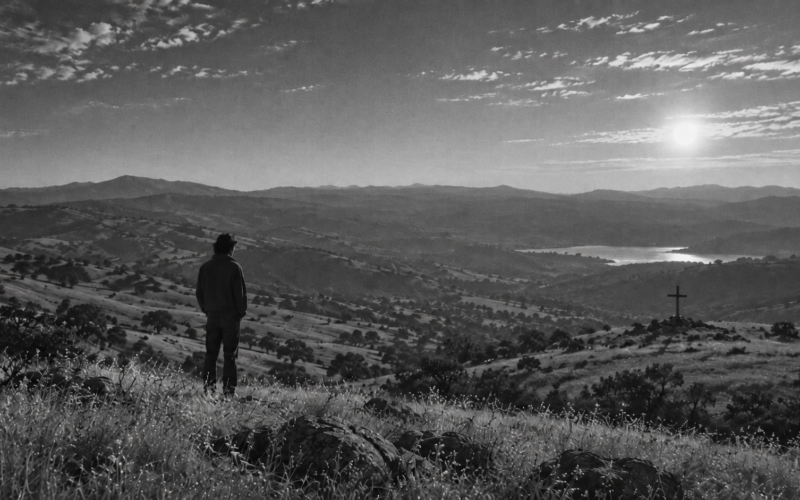

The call comes at the worst possible hour, or the diagnosis lands on an ordinary Tuesday, or the marriage that seemed steady finally gives way, and in the middle of it a question surfaces that feels almost involuntary. What did I do to deserve this. It’s rarely spoken out loud, but it sits underneath the grief like a current, pulling the mind toward an explanation that at least makes the pain make sense. If this is punishment, then there’s a logic to it, a scoreboard, a God who’s settling something. That thought can feel more bearable than the alternative, which is that suffering sometimes arrives with no ledger behind it at all.
This question deserves a real answer, not a spiritualized shrug. Scripture doesn’t treat suffering as a puzzle to be waved away, and it doesn’t pretend that pain and consequence are unrelated. But it draws a sharp line between the natural weight of living in a broken world, the very real consequences that follow certain choices, and the idea that God is somewhere in heaven tallying up wrongs and dispensing tragedy as payment. That line matters, and most of the confusion people carry about God’s character starts from blurring it.
A World That Groans
Cancer existed before any single person’s sin gave it a reason to exist in their body. Violence didn’t wait for a particular victim to earn it. These things are baked into the fabric of a creation that fell, not dispensed individually as verdicts. Paul writes about this directly, describing a creation subjected to futility and waiting for its own liberation.
Romans 8:22
For we know that the whole creation has been groaning together in the pains of childbirth until now.
That groaning isn’t selective. It doesn’t skip the faithful and target the guilty. A hurricane doesn’t consult a moral record before it levels a coastline, and a cell doesn’t mutate into malignancy because someone deserved it more than their neighbor. The world carries the weight of a fall that touched everything, soil and bodies and weather systems alike, and until that fall is finally undone, suffering will keep showing up uninvited, with no personal explanation attached.
This is hard to sit with because people want causes. A cause gives the illusion of control, since if suffering follows sin in a direct line, then avoiding sin becomes a kind of insurance policy. But that isn’t how a fallen world works, and treating it that way sets people up for a crueler blow later, when tragedy strikes someone who did everything right.
When Pain Is the Echo of Choice
At the same time, some suffering really does trace back to choices, our own or someone else’s. A life built on deception tends to collapse under its own weight eventually. A body treated carelessly for decades often responds in kind. This is where the confusion between consequence and punishment gets thickest, because from the inside they can feel identical.
Consequence is what happens when a choice plays out to its natural end. Punishment is a penalty imposed for the purpose of settling a debt. The distinction isn’t a technicality, because Christ already carried the punishment for sin on the cross, fully and completely, which means that debt can’t be reopened and billed again to someone who’s already been forgiven.
Romans 6:23
For the wages of sin is death, but the free gift of God is eternal life in Christ Jesus our Lord.
A believer can still feel the aftershocks of a decision made years earlier, still lose a friendship or a career or years of health to something set in motion long before faith entered the picture. That pain is real and it deserves to be grieved honestly. But it isn’t God exacting revenge. It’s a broken world running its course, and even inside that course, grace is doing something the world’s logic can’t account for.
Near to the Brokenhearted
If suffering isn’t punishment, the next question follows naturally. Does that mean God removes it for those who trust him. The answer, plainly, is no. What he promises instead is nearness, and that promise shows up most clearly at the exact point where a person feels most abandoned.
Psalm 34:18
The LORD is near to the brokenhearted and saves the crushed in spirit.
Nearness, not exemption. That’s a hard trade for a culture that wants pain solved rather than accompanied, but it’s the actual offer on the table. Anyone preaching that faith functions as a shortcut past hardship is selling something Scripture never promised. Following Christ has never come with a guarantee of an easier road, and in plenty of recorded lives it produced the opposite, prison instead of comfort, loss instead of gain, a cross instead of a crown, at least by the world’s math.
What changes isn’t the presence of hardship but the presence inside it. A person walking through loss without God walks through it alone, working to construct meaning out of raw material that offers none. A person walking through the same loss with God still feels the full weight of it, still weeps and still asks why, but does so with a companion who has already promised not to leave.
Peace That Does Not Wait for Resolution
So what does the believer actually receive, if not an easier life. Peace, and it’s a peace that doesn’t require the circumstances to change first. That’s the part the world struggles to understand, since most peace is contingent, built on the resolution of whatever caused the disturbance. This peace works differently, sitting underneath the unresolved thing rather than waiting for it to be fixed.
Philippians 4:7
And the peace of God, which surpasses all understanding, will guard your hearts and your minds in Christ Jesus.
That peace comes with a horizon attached to it, a promise that the current state of things isn’t the final state of things. God will return and make right what’s broken, will wipe every tear and undo every wrong, and that future isn’t a vague hope tacked onto the end of a hard sermon; it’s the anchor the whole thing rests on. Suffering doesn’t get explained away by that promise, and it doesn’t need to be, because what’s offered instead is sturdier than an explanation. It’s a person who stays close through the worst of it and a future where none of it gets the last word.