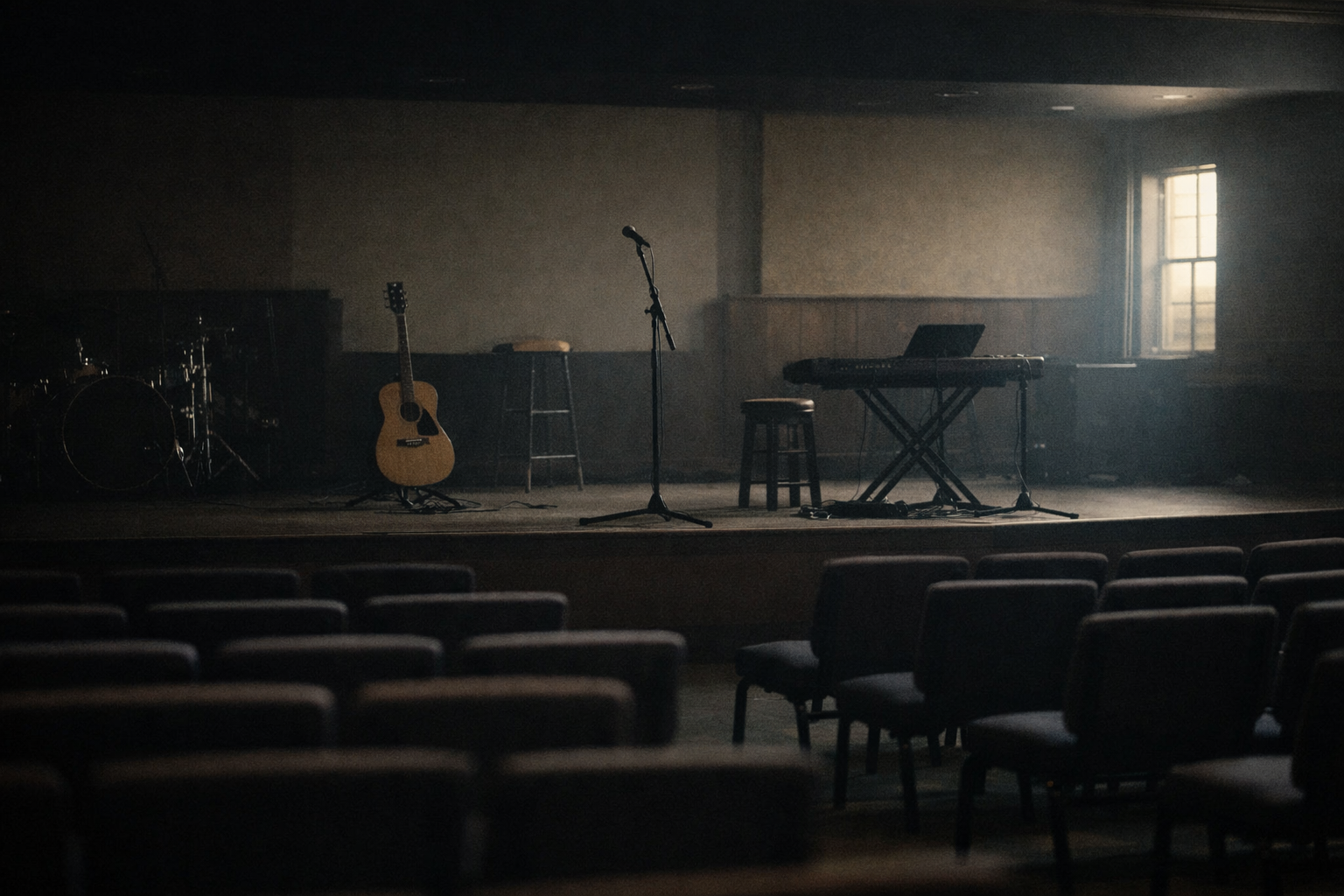

We’re humans, fallen humans at that. Nothing in us is good, even when we’re trying to worship our creator. Our minds don’t carry enough guardrails to keep us from pointing the finger back at ourselves, at others, or slipping into habits that create faulty processing within our spirits. It’s the plight of man, and it’s why most of Paul’s letters were written to the very churches professing Christ.
Many believers have felt that tension, even if they haven’t known quite what to call it. There are gatherings where the atmosphere feels settled in the right way, where the attention of the room seems quietly ordered toward the Lord. Then there are moments when something feels unsettled under a polished surface, but nothing may appear obviously wrong. The music may be skillful, the people may be thoughtful in their presentation, and the language may sound familiar and sincere.
Still, a room can begin to feel governed more by human presence than by reverence. You can feel the eyes shifting and attention navigating the pews or hallways. We’ve all seen it or participated in it. Not fundamentally looking at it as a bad thing, but knowing deep down that something is amiss.
Vanity isn’t a minor concern in Scripture. It’s more than an issue of outward style because it touches the matter of glory, which means it belongs in any serious conversation about worship. The gathered church is where God’s people come before Him, where the Word is opened, where Christ is proclaimed, and where the soul should be drawn away from self-occupation and back toward the Lord. When something interferes with that movement, it deserves careful attention.
Vanity Reaches Further Than Appearance
When people hear the word vanity, they often think first about appearance. They think about the desire to look attractive, polished, or impressive. That’s part of the subject, but it isn’t the whole of it. Vanity reaches below outward presentation into motive, attention, and the inward need to be established in the eyes of others. A person may appear restrained and still be governed by vanity. Someone else may carry visible dignity and care without being ruled by it. The outward form can’t answer the question by itself.
1 Samuel 16:7 For the Lord sees not as man sees: man looks on the outward appearance, but the Lord looks on the heart.
That verse is often quoted, but it’s not a decorative truth, because it exposes the difference between human judgment and God’s. People are naturally drawn to what can be noticed and assessed, but God sees what lies underneath the visible form. He sees what a person is seeking when they enter the room. He sees whether worship is sincere or whether the heart is leaning, even quietly, toward affirmation from other people.
This should be a gut check for every believer reading this, because how many times have we quietly watched others, or hoped others were watching us? Worn a thing, crafted a statement, said a prayer, gave a hug. It’s all there, every week. Let us use this moment to reflect and ask the Lord to search our hearts.
Vanity begins wherever the self starts to occupy a place it was never meant to hold. It turns inward toward recognition, regard, and personal importance in a setting that belongs to God. It attaches itself to far more than physical appearance, moving through giftedness, public usefulness, spiritual language, and even a carefully guarded reputation for humility, because the flesh will make use of whatever keeps it near the center.
Being in Church Doesn’t Solve the Problem
It would be comforting if the church simply washed all of this away, but the Bible is very direct about the fact that people can stand near holy things while carrying mixed motives. Religious spaces aren’t protected from pride simply because they’re religious spaces.
Matthew 6:1 Beware of practicing your righteousness before other people in order to be seen by them, for then you will have no reward from your Father who is in heaven.
His warning reaches further than open hypocrisy. It speaks to the tendency in all of us to turn even good and rightful actions into occasions for self-display. A person may pray, serve, give, or speak truthfully while still wanting something from the room that has little to do with God. The act itself may remain outwardly proper, yet the heart may already have shifted.
John 5:44 How can you believe, when you receive glory from one another and do not seek the glory that comes from the only God?
The desire for human approval doesn’t simply create an unfortunate habit at the edges of faith. It affects the soul’s ability to live honestly before God. When a person grows accustomed to looking sideways for affirmation, spiritual clarity begins to weaken. The church may continue with its ordinary life, but something inside it starts to erode.
So yes, vanity can live in church life. Church attendance or visible involvement in ministry doesn’t remove it either. The problem lies deeper than outward participation. It has to do with what the heart loves and what the heart is asking from worship.
How Vanity Works Its Way Into Church Life
Service becomes one place where this quietly surfaces. Someone may be eager for visible responsibility while resisting forms of faithfulness that remain unseen. We may speak often about calling and usefulness, while what’s really driving us is the desire to feel significant in the eyes of others. Because the language sounds spiritual, the deeper motive can remain hidden for a long time.
The social experience of church carries its own version. We arrive outwardly ready to worship, yet inwardly preoccupied with where we stand in relation to others in the room, scanning for who is noticed, trusted, or established, and whether we feel secure within that world. That kind of inward comparison is easy to dismiss because nothing dramatic is happening on the surface. Even so, it changes the way a person stands before God, because the heart becomes restless and divided.
Over time, those same instincts can begin shaping the church itself. A congregation may slowly become more sensitive to presentation than to integrity, giving greater weight to what appears strong and appealing than to what is spiritually solid. Beauty, skill, and thoughtful order can be fitting expressions of care in many settings. The difficulty begins when those things start carrying more meaning than they should, or when they begin to conceal a lack of depth that should have been addressed more honestly.
Vanity rarely shows up as open rebellion. It arrives in acceptable clothing, sounding disciplined, respectable, and even devout. That’s why a faithful response requires more than surface judgment.
Reverence Shouldn’t Be Confused With Vanity
Some believers respond to the subject of vanity by growing suspicious of every visible expression of beauty, preparation, or dignity, and that suspicion creates its own distortion. Scripture doesn’t teach that carelessness is a sign of holiness.
A real difference separates self-display from reverence. A person may dress thoughtfully because they want to carry themselves with seriousness before God. A musician may prepare carefully because worship shouldn’t be handled casually. A church may value order and beauty because those things can reflect, however imperfectly, the worth of what is taking place. None of this should be dismissed too quickly.
Colossians 3:17 And whatever you do, in word or deed, do everything in the name of the Lord Jesus, giving thanks to God the Father through him.
That verse gives a truer measure than outward rules can provide. It brings the question back to the center. What is this for? What is governing this act, this presentation, this effort? Is it being offered before the Lord with gratitude, or is it quietly being used to reinforce the self? Those aren’t always easy questions, but they’re better questions than the ones that focus only on what can be seen.
That’s also why legalism can’t cure vanity. The heart can remain proud under very restrained outward forms. It’s possible to reduce external display while leaving self-importance untouched. Vanity isn’t defeated when everything looks plain. It begins to lose its hold when the soul is reordered before God.
The Issue Beneath It All Is Glory
The gathered life of the church exists to direct attention where it belongs, toward who is meant to be weighty in worship. We don’t come together to secure an identity in the eyes of other people. We come because God is worthy of worship. His truth addresses us, and our lives need to be reoriented around Him again and again.
Psalm 115:1 Not to us, O Lord, not to us, but to your name give glory, for the sake of your steadfast love and your faithfulness!
God receives the glory that already belongs to Him. No gathering can trade that away for the reinforcement of our own image. When that reality settles into a church, more than its language changes. People become less eager to protect an impression, and comparison begins to lose some of its force. The need to be thought well of no longer feels as decisive as it once did.
Vanity is easy to notice in forms that irritate us. It’s harder to recognize when it works through our own habits, preferences, or insecurities. A person may genuinely come to church to worship and still carry an inward desire to be affirmed, respected, or quietly secured by the response of other people. The presence of that struggle doesn’t make someone false, but it does reveal where the heart needs honesty before God.
It helps to ask what we’re really looking for when we enter the house of God. Would it trouble us more to be overlooked by people, or to leave without having met with God in truth? Questions like those begin to uncover the places where vanity still quietly holds on.
Returning to Worship More Honestly
Cynicism about church life, or standing back to keep score on other people’s weaknesses, doesn’t answer vanity. Humility does, and so does remembering what worship is for.
James 4:6 God opposes the proud but gives grace to the humble.
Pride resists worship because it keeps drawing the soul back toward itself, while humility is willing to stand before God without managing an image. It’s honest about mixed motives, and it lets the Lord search what lies beneath outward participation.
The church should be one of the few places where a person no longer needs to perform. Worship isn’t casual. It’s serious enough to strip away pretense. We gather because we need mercy, because Christ is worthy, and because the soul cannot be healed by human attention.
A better way forward begins when we stop managing ourselves before others and come honestly before God. We ask the Lord to search us, to straighten what has become inwardly bent, and to teach us how to stand before Him with sincerity. Reverence grows there, in the place where the self becomes smaller, and God is seen more clearly.