





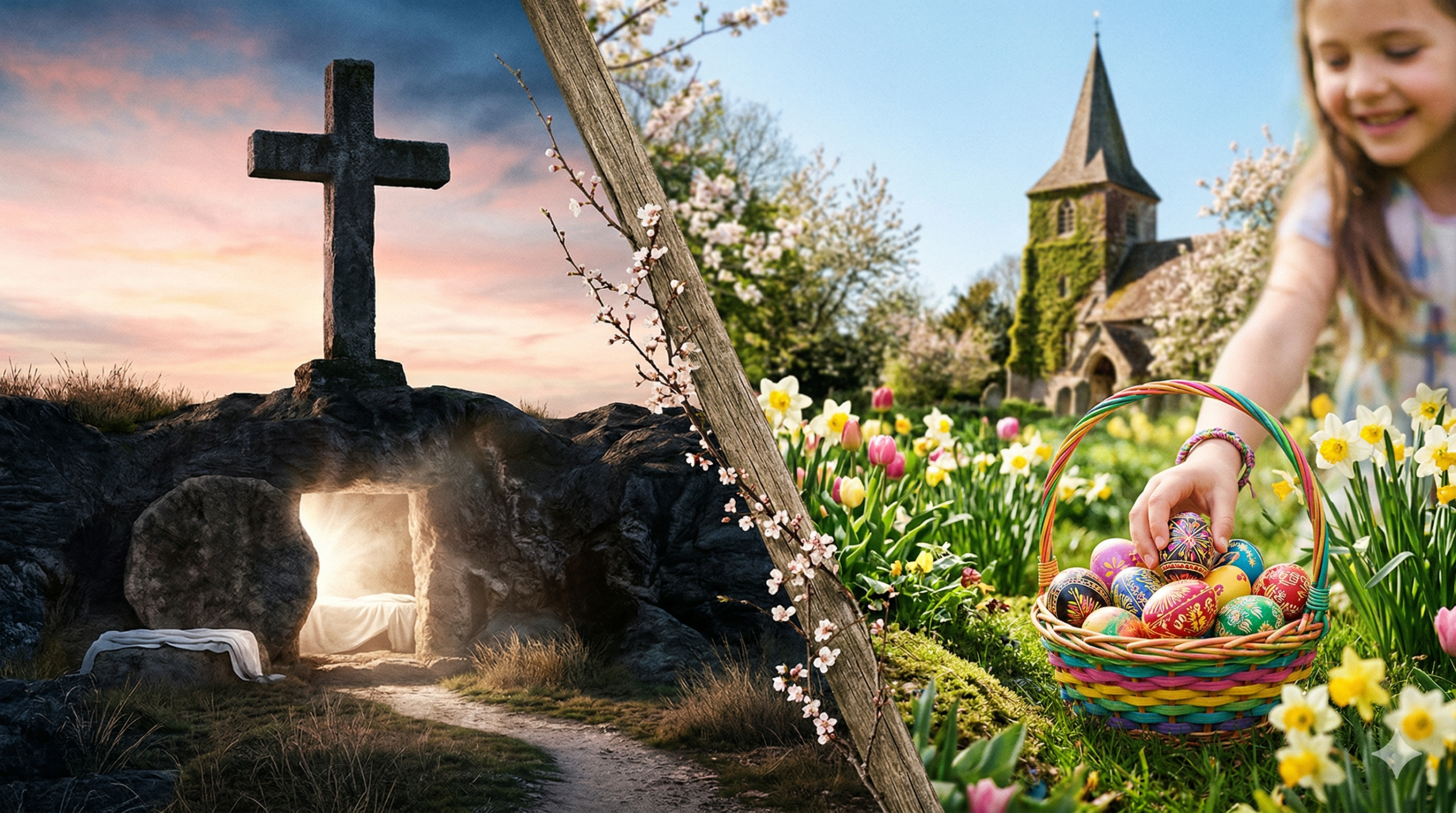
The Split We Don’t Talk About
Easter carries a rhythm most people rarely stop to examine. The morning feels settled. People gather, dress with intention, and sit beneath the weight of something they do not approach the same way the rest of the year. Even many who do not regularly attend church will often show up. There is still some shared awareness that this day means more than an ordinary Sunday, even when no one says it plainly.
By afternoon, the atmosphere changes.
Nothing dramatic needs to happen. The day just begins to move in another direction. Baskets appear, candy is handed around, children run through yards looking for eggs, and somewhere in the middle of all of it, the center of the day begins to feel less distinct.
No one has to announce that a change has taken place. No one says Christ has been replaced. It happens more quietly than that, almost gently, as though these different meanings belong together and do not need much thought.
That is where the question begins to rise.
What are we actually doing?
Not as a suspicious question, but as an honest one. What are we participating in, and how do those things relate to each other? Is this one coherent celebration, or have two different meanings been placed across the same day without ever being brought together?
Most Christians do not spend much time wrestling with that. Not because they are careless, but because the pattern was handed to them before they ever thought to question it. Easter arrived with a structure already in place. Church in the morning. Tradition in the afternoon. It never felt strange enough to stop and examine.
That does not always feel like conflict. Often it just feels normal. Still, normal is not the same thing as thoughtful, and inherited patterns can remain in place for years without anyone asking what they are teaching.
What Easter Actually Is
Before anything else can be sorted out, Easter has to be returned to what it is.
Not what culture has built around it. Not what it feels like in memory. Not even the collection of habits many of us grew up with.
Easter is the recognition of something that either happened or did not happen, and the Christian faith stands or falls on that reality.
The resurrection of Jesus is not a decorative part of Christianity. It is not a seasonal emphasis or a meaningful tradition set beside others. It is central to everything Christians confess about sin, salvation, judgment, hope, and the person of Christ.
1 Corinthians 15:14 “And if Christ has not been raised, then our preaching is in vain and your faith is in vain.”
Paul does not leave room for a softened version of that claim. If the resurrection did not happen, Christian belief does not merely weaken. It collapses.
If it did happen, then everything else has to be understood in light of it.
Romans 6:9 “We know that Christ, being raised from the dead, will never die again; death no longer has dominion over him.”
That is not symbolic reassurance. It is a claim about what is true. Death, which marks the boundary of every human life, does not hold Christ. That changes what hope is. It changes what forgiveness is. It changes what it means to belong to Him at all.
So Easter is not just a day Christians observe once a year. It names the reality their lives are built upon. That is why the way we move through this day matters. Not because the date itself holds some kind of spiritual power, but because our habits around the day reveal what we believe the resurrection is worth.
Where the Tension Enters
The tension here is not artificial. It does not come from people trying too hard to complicate a simple matter. It comes from the fact that culture rarely leaves sacred things untouched. Over time, it reshapes them into forms that are easier to carry, easier to share, and easier to enjoy without much reflection.
That process usually does not feel aggressive. More often it feels harmless. It arrives through color, family custom, and sentimental memory. It becomes familiar long before anyone asks what it means.
Eventually, what was once central begins sharing space with things that were never meant to carry the same meaning.
Eggs become symbols of life, though not in the way Scripture speaks of life. Rabbits become part of the celebration, not because they tell the story of the resurrection, but because they fit a wider seasonal story about spring, fertility, and renewal. These things do not force their way in through argument. They settle in through repetition.
That is part of what makes the issue difficult. An egg hunt does not feel like a denial of Christ. A basket of candy does not feel like rebellion. Most people do not encounter these things as threats, so they do not think to question them.
Still, the question is not whether they are openly hostile. The question is whether they are truly aligned with the meaning of the day.
These symbols were not built to hold the weight of the resurrection. They were attached later, laid over something that already had its own meaning. Once that happens, they begin to shape the way Easter is felt and remembered, especially by children who are still learning what the day is for.
Culture usually does not remove meaning all at once. It surrounds, softens its edges, and gives it company until the original center no longer feels central in practice.
That is the tension. Something can remain present and still lose clarity.
Participation Is Never Neutral
At some point the conversation has to move beyond asking what is technically permitted.
It is easy to ask whether something is allowed. It is harder to ask what it is doing to us, what it is teaching, and what kind of instincts it is forming.
The New Testament often presses in that direction.
1 Corinthians 10:23 “All things are lawful, but not all things are helpful. All things are lawful, but not all things build up.”
That changes the shape of the question. It is no longer only, “Can I do this?” It becomes, “What comes from this? What does this reinforce? What kind of weight does this give to one thing over another?”
Participation always forms something, even when that shaping happens quietly.
If a child grows up feeling that Easter is mainly about candy, baskets, and the excitement of what waits in the yard, those things begin to occupy the emotional center of the day. The resurrection may still be mentioned, but it may not be what the day most deeply feels like it is about.
Over time, that matters. What people repeatedly experience as central often becomes what they understand as central.
That does not mean every family that keeps cultural traditions is rejecting Christ. It does mean these practices are not empty. They do not sit there doing nothing.
The Ways Christians Usually Handle It
When Christians approach Easter thoughtfully, they often land in one of a few familiar places.
Some remove themselves almost entirely from the cultural side of the holiday. No eggs, no baskets, no Easter bunny. The aim is clarity. Nothing else is allowed to compete with the resurrection.
There is something admirable in that instinct. It recognizes that the day already carries enough weight on its own. At the same time, this approach can become thin if it is defined mostly by refusal. If the choice is not rooted in conviction and understanding, it can harden into reaction.
Others try to rework the cultural material into something usable. Eggs become symbols that can be explained. Familiar traditions are given Christian framing. Events are created that resemble the surrounding culture while trying to point people back to Christ.
That often comes from a sincere desire to meet people where they are. Still, there is a real risk in assuming that Christian language automatically changes the meaning of the practice. Sometimes the older meaning remains in place beneath the new explanation, and the result is not clarity but mixture.
Then there is the most common pattern, which is less a deliberate position than simple inheritance. Church in the morning. Traditions later. No one feels pressure to connect the two, and no one feels pressure to separate them. The day moves along as it always has.
That pattern usually does not come from rebellion. It comes from familiarity. Even so, it can be the most dangerous position precisely because it asks so little. Meaning can shift while everyone involved still feels as though nothing important has changed.
So Can You Do Both?
This is usually the point where people want a clean answer.
They want a line that settles the matter once and for all, either by condemning the traditions outright or by assuring everyone that none of it really matters. Scripture does not usually handle these kinds of questions that way. It asks more of us than a quick ruling.
It is possible to participate in certain traditions without rejecting the resurrection. That much is true. But it does not follow that those traditions are neutral, or wise, or equally helpful in every home.
The harder question is the one that forces honesty.
Does this deepen our attention to the resurrection, or does it simply sit beside it?
What carries the emotional weight of the day in our home?
What are our children learning from what is emphasized, anticipated, and talked about most?
An egg hunt does not erase the resurrection. That is not the concern. The concern is that it can quietly rearrange the day unless someone is paying attention to what is being centered.
And once that rearrangement becomes normal, it rarely feels like rearrangement anymore.
Conscience Must Be Formed, Not Assumed
Romans 14:5 “Each one should be fully convinced in his own mind.”
That verse is sometimes used as a quick way to end difficult conversations, but it asks for more than that. It does not excuse thoughtlessness. It requires maturity.
Conscience is not meant to drift along without examination. It has to be shaped.
You are not required to borrow someone else’s convictions, but neither are you free to move through these questions without weighing them carefully. To be fully convinced means more than following instinct or repeating what your family always did. It means you have considered what your participation says, what it forms, and what it places at the center.
Two Christians may reach different conclusions about how to handle cultural Easter traditions. That does not automatically mean one is faithful and the other is compromised. But both are responsible for arriving where they arrive honestly, with open eyes, and with a conscience that has been trained rather than assumed.
A More Careful Way Forward
There may not be one model every Christian family must follow, but there is a way of approaching Easter that takes its meaning seriously.
The resurrection should not feel like one feature of the day among many. It should stand at the center, with everything else either ordered beneath it or set aside.
That does not require fear. It does not require rigid performance. It does require attention.
If certain traditions are kept, they should be held deliberately rather than automatically. If certain things are removed, that should happen from conviction rather than panic. In either case, the aim is not to manage appearances. It is to guard clarity.
Some Christians will conclude that certain traditions are no longer worth keeping. Others may keep some of them carefully, while refusing to let them shape the meaning of the day. But no Christian should move through Easter without asking what is being reinforced by the way it is celebrated.
What We Teach Without Saying
Households teach by emphasis long before they teach by explanation.
Children learn what matters by what is anticipated, what receives the most energy, what is spoken about with delight, and what is treated as the real center of the day.
If the resurrection is true, it does not need help becoming meaningful. Its meaning already stands. But it can be crowded in practice when everything around it is given equal weight, equal excitement, and equal attention.
That kind of drift rarely happens all at once. It happens slowly, through patterns that become so familiar that no one thinks to question them.
Easter does not need to be made important. It already is.
What Christians need is the willingness to recognize that, and then to order the day with enough care that the meaning of the resurrection is not quietly pushed to the side.