





Manhood Is More Than Image
One of the great lies of modern culture is that manhood can be reduced to appearance. The world offers men a series of substitutes and presents them as the real thing. Strength, money, sexual success, status, confidence, influence, and dominance are all treated as proof of manhood, as though outward force or visible success could establish what a man is. What culture often celebrates is not character, but image. It hands men a costume and suggests they have become something substantial simply by putting it on.
Biblical manhood begins somewhere deeper than that. It is not built on image, performance, or the ability to impress other people. It is built on responsibility before God and submission to God.
That is part of what makes manhood weighty. To be a man is not simply to grow older, inhabit a male body, earn money, or develop strong opinions. The deeper question is whether a man is willing to live under the authority of God, accept responsibility for his life, and walk in obedience even when obedience costs him something.
That kind of manhood rarely looks dramatic. More often, it takes shape in quiet faithfulness. It shows itself in discipline rather than indulgence, in humility instead of pride, and in endurance when escape would be easier. It requires honesty about the condition of the heart, which means a man cannot spend his life blaming everyone around him for what he refuses to confront in himself.
The Problem Is Not Outside of Us
Many men live as though the main problem is always somewhere beyond them. They point to culture, women, politics, their upbringing, money, lost opportunities, pressure, or the broader system around them. Some of those things do shape a man’s circumstances, and it would be dishonest to pretend otherwise. But Scripture keeps pressing deeper than circumstance and exposing the condition of the person himself.
The deepest problem of man is not first external. It is internal. Scripture does not let us explain ourselves entirely by environment, because it keeps bringing us back to sin, to the disorder of the heart, and to the fact that what is wrong in us cannot be solved by better optics or stronger self-management.
That is why the gospel is so necessary, and it is why these earlier theological foundations matter so much. If humanity needs salvation, then men need salvation. If God is holy, then men are accountable to that holiness. If good works cannot save us, then a man cannot build righteousness through outward toughness or personal performance. If a person must be born again, then manhood itself must be reshaped by the Spirit of God rather than merely strengthened in natural terms.
This is where many men go wrong. They work hard to construct a stronger version of themselves without ever dealing honestly with sin. They become more disciplined, more driven, or more outwardly masculine in the eyes of the world, while remaining fundamentally unsubmissive before God. The result may look impressive for a time, but it is still a form of self-improvement rather than biblical manhood.
Romans 3:23
“For all have sinned and fall short of the glory of God.”
Manhood begins to take a truthful shape when a man stops managing appearances and begins to deal honestly with God. That honesty is painful because it strips away pride, excuse, and the habit of rationalizing sin. But without it, there can be no real growth.
The Weight of Responsibility
A man who refuses responsibility will usually build his life around avoidance. That avoidance may take different forms depending on the person. One man buries himself in work. Another hides behind anger or humor. Another gives himself to entertainment, sexual sin, substances, or restless ambition. The form changes, but the instinct is the same. He does not want to face what God is calling him to face.
That avoidance always comes at a cost.
God does not call men to drift through life untouched by duty. He calls them to live with steadiness, to take responsibility where responsibility has been given, to repent when they are wrong, and to endure hardship without surrendering to self-pity. He calls them to remain anchored in truth when everything around them feels unstable.
That responsibility will not look identical in every season. For some men, it includes leading a wife and children with humility, consistency, and care. For others, it means learning discipline, honesty, sexual integrity, and a godly work ethic before they are ever entrusted with more. But in every season, a man is called away from passivity.
Passivity ruins many men long before anything outwardly dramatic happens. It does not always appear as open rebellion. More often, it takes the form of delay, excuse, distraction, and spiritual laziness. A man does not need to become publicly destructive to waste his life. In many cases, he simply avoids the obedience God has placed in front of him until neglect becomes a pattern and the pattern becomes part of his character.
That is why responsibility is central to biblical manhood. A godly man is not a sinless man, but he is an accountable one. He does not spend his life running from truth. He does not settle comfortably into compromise. He understands that no one else is meant to carry the burden of obedience for him.
Strength Under Submission
The world usually speaks of strength in terms of self-assertion. It treats strength as the power to dominate, protect personal autonomy, or impose one’s will. Scripture presents something far better and far harder. True strength is formed under the authority of God.
To a culture obsessed with control, that may sound weak. In reality, it exposes the difference between appearance and substance. A man may know how to command a room and still be ruled by his appetites. He may project confidence and still be incapable of repentance. He may look powerful in public while remaining inwardly governed by lust, pride, anger, fear, or insecurity.
Biblical strength has a different quality to it. It is marked by restraint, humility, obedience, and a willingness to serve. It does not collapse the moment life becomes painful, and it does not need domination in order to feel secure. A man who cannot govern himself is not strong in any meaningful sense, no matter how forcefully he carries himself.
1 Corinthians 16:13–14
“Be watchful, stand firm in the faith, act like men, be strong. Let all that you do be done in love.”
That passage is helpful because it refuses to separate strength from love. The world often divides them and leaves men with a distorted picture of both. It praises hardness without holiness, confidence without submission, and intensity without gentleness. Scripture does not allow that division. A man is called to be strong, but his strength must remain under Christ, which means love is not a softening of manhood but part of its proper shape.
Men Are Not Formed in Isolation
Another lie many men believe is that they can become who they need to be on their own. Isolation often feels appealing because it gives a man room to avoid exposure, correction, and accountability. But what feels like independence often becomes a place of distortion. Left to himself, a man will usually excuse what needs to be confronted and protect what needs to be put to death.
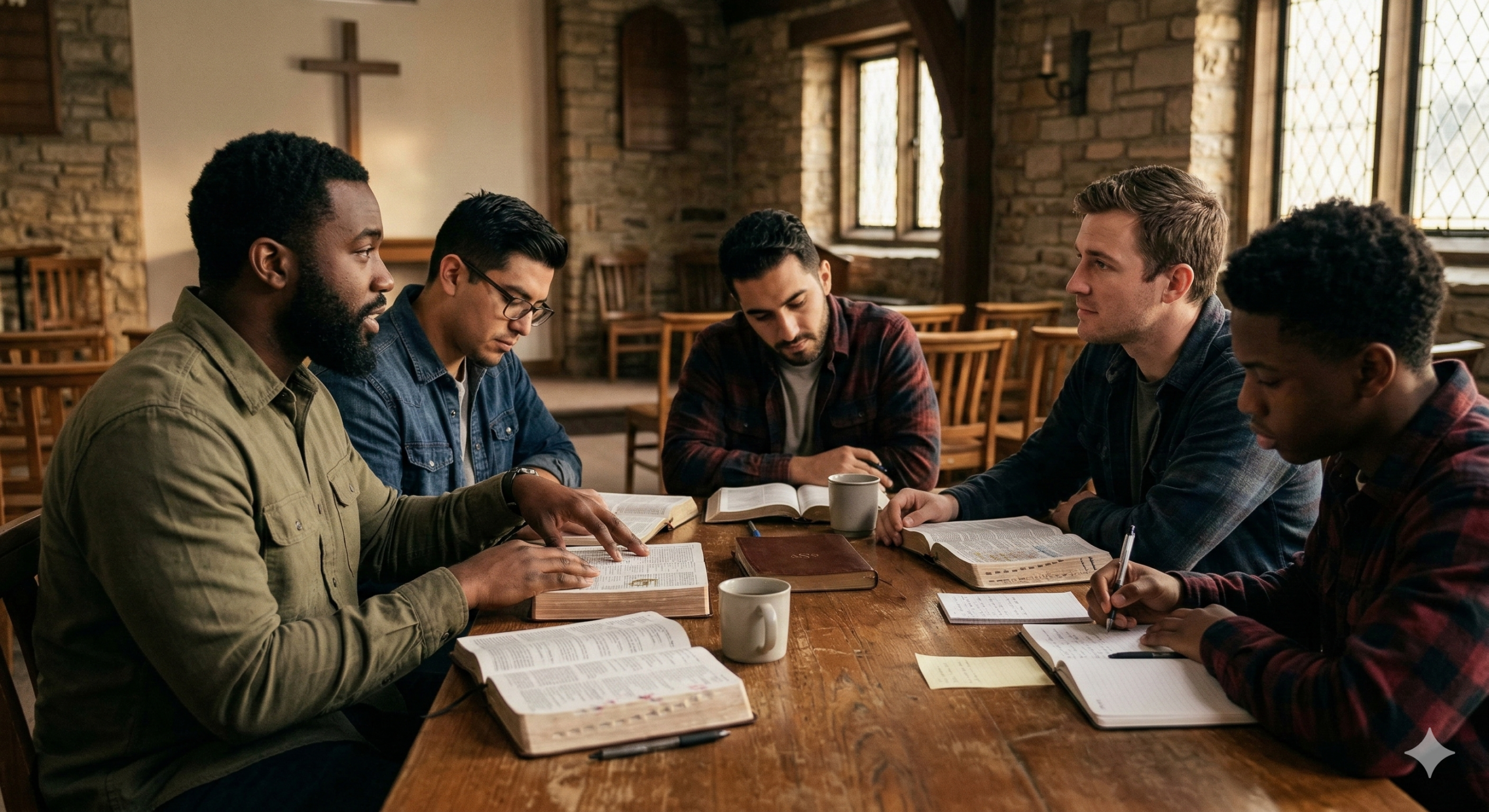
Men are not formed well in isolation. They need the Word of God, the life of the church, and the steadying influence of faithful brotherhood. Without those things, they will be shaped by something else. Culture, appetite, pain, ego, resentment, and whatever voice speaks most loudly will begin to take the governing role that belongs to God.
Psalm 119:9
“How can a young man keep his way pure? By guarding it according to your word.”
That is why Scripture matters so much here. A man who is not being governed by the Word of God will not remain neutral. He will be formed by another authority, even if he continues using religious language. The real question is never whether a man is being shaped, but what is shaping him.
The church matters for the same reason. Men need discipleship, correction, encouragement, and spiritual seriousness around them. They need relationships in which obedience is spoken of plainly and sin is not protected by secrecy. Faith is not a private fantasy. It is a life of obedience lived before God and among His people.
This is not because men are uniquely broken in comparison to everyone else. It is because men, like all people, need grace, truth, and sanctification. But when men reject those gifts, the damage rarely remains private. It spills outward and harms the people around them.
The Inner War of Manhood
Part of the weight of being a man is learning that some of the deepest battles are invisible. Outward pressures are real, but they are not always the greatest threat. Sometimes the more dangerous problem is the inner life that has been neglected for years.
This is where many men lose ground. Not always in public collapse, but in private compromise. Lust is entertained. Sin is left unconfessed. Bitterness is allowed to mature. Pride remains untouched. Spiritual neglect hardens into habit. Over time, what was once resisted begins to feel normal, and what should have driven a man to repentance becomes part of the structure of his life.
This connects directly to the larger truth that Christians still struggle with sin even after coming to Christ. Conversion does not remove the need for vigilance. A man is still called to fight the flesh, to walk by the Spirit, and to take holiness seriously. The difference is that he is no longer abandoned to himself in that fight. He is being sanctified by God.
Galatians 5:16
“But I say, walk by the Spirit, and you will not gratify the desires of the flesh.”
A man’s inner life matters far more than many are willing to admit. His thought life matters. His habits matter. His private obedience matters. The hidden parts of a man do not sit outside discipleship. They are often where discipleship proves whether it is real. A man who learns to pursue obedience before God in secret will be far better prepared to stand faithfully in public.
Manhood Is Measured by Obedience
Many men want significance, but not all of them want obedience. They want the weight of manhood without the surrender it requires. They want influence, strength, leadership, and purpose, but they do not want repentance, holiness, sacrifice, or submission. Scripture does not allow manhood to be defined on those terms.
The measure of a man is not how impressive he appears. It is whether he is willing to obey God when no one is applauding.
That obedience often looks ordinary, which is one reason the world rarely notices it. It may look like remaining faithful to your wife over many years, working hard without constant complaint, confessing sin instead of hiding it, showing up for your children, praying when your heart feels numb, or opening Scripture when distraction would be easier. It may also look like enduring a difficult season without walking away from the Lord.
This is why manhood cannot be reduced to style, intensity, or forceful language. A man may sound bold and still be spiritually hollow. He may know how to project conviction and still avoid the slow obedience by which godliness is actually formed over time.
Micah 6:8
“He has told you, O man, what is good; and what does the Lord require of you but to do justice, and to love kindness, and to walk humbly with your God?”
That is part of the invisible weight of manhood. It is not mainly about being admired. It is about being faithful.
The Weight Is Real, but So Is Grace
If all of this feels heavy, that is because it is. Responsibility is heavy. Obedience is costly. Repentance is humbling. Leadership can be difficult. Endurance often requires more than a man feels he has. A man who takes God seriously will feel that weight at times, and he should not be surprised by it.
But the answer is not despair. The answer is grace.
Men are not called to bear the burden of manhood through self-generated strength. They are called to walk under the grace of God, through the power of the Holy Spirit, and with their eyes fixed on Christ. The same gospel that exposes sin is the gospel that saves, restores, and sanctifies. The same God who commands obedience is the God who gives strength for it.
A man does not become godly by pretending he is sufficient in himself. He becomes godly by learning to depend on God honestly, steadily, and without illusion. That dependence is not weakness. It is wisdom.
The weight of manhood becomes destructive when it is carried apart from God. Under Christ, that same weight becomes part of the way a man is formed. It humbles him, teaches him, and makes him useful for the glory of God.