





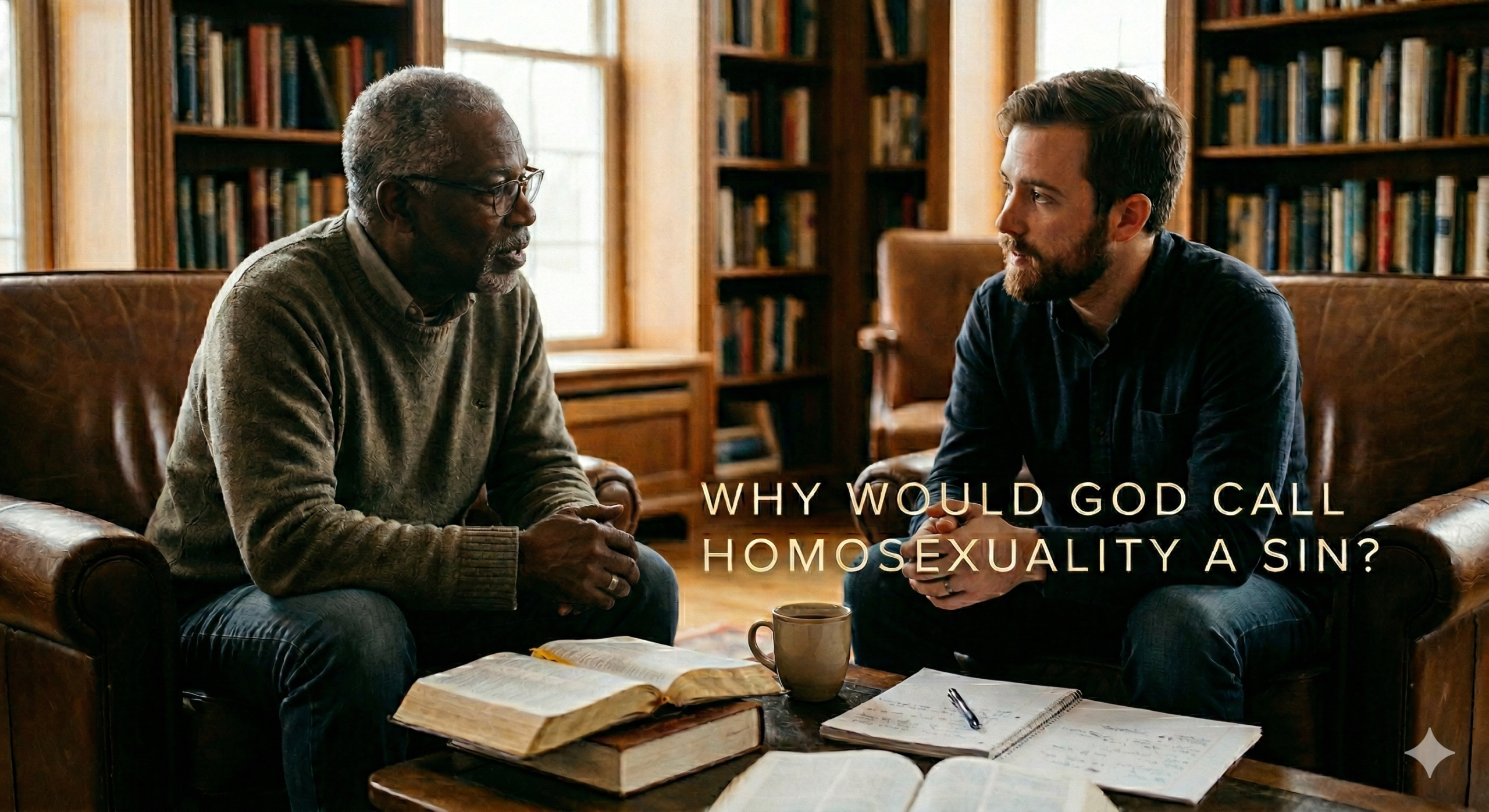
Why This Question Feels So Personal
Few questions feel more sensitive than this one, because for many people it is not a distant theological issue but something bound up with love, family, shame, belonging, rejection, and the desire to be known without being treated with contempt.
Some ask because they sincerely want to understand what Christianity teaches. Others ask because someone they love identifies as gay, and they cannot understand why God would place moral limits around something that seems emotionally real and deeply personal. Others ask because they have seen Christians speak about homosexuality in ways so cold or hostile that the church itself began to feel unrecognizable.
That history matters, because Christians have often handled this subject poorly. At times, believers have spoken as though homosexuality were uniquely serious while showing far less concern over other sins that are common and often tolerated in church life, including pride, lust, greed, gossip, bitterness, adultery, and hypocrisy. When that happens, the issue is no longer only what Scripture says. It also becomes a question of whether Christians are willing to speak truth with humility, or whether they are using God’s name to justify a hostility they already wanted to express.
Still, the failures of Christians do not answer the deeper question. However badly this issue has been handled, the central matter remains the same. If God made us, then He has the authority to define holiness, including sexual holiness. If that is true, then the question cannot be answered simply by asking what feels sincere or natural to us. It has to be answered by listening to what He has said.
The Issue Runs Deeper Than One Desire
One of the most common mistakes in this conversation is treating homosexuality as though it exists outside the ordinary reality of human sin, as though this is one unusual form of brokenness while everything else is more or less normal.
The Bible does not describe the human condition that way, because Scripture teaches that sin has affected every part of us. It shapes not only our actions, but also our desires, loves, imaginations, instincts, and the inward direction of the heart. That means every person, in one form or another, experiences desires that do not fit the will of God.
For one person, that may involve same-sex attraction. For another, it may involve pornography, adultery, envy, rage, greed, drunkenness, control, or the steady habit of self-worship. The forms are different, but the deeper problem is shared by all of us. Human beings are not morally whole people who occasionally make mistakes. We are fallen people whose hearts do not remain naturally ordered toward God.
Romans 3:23
“for all have sinned and fall short of the glory of God.”
That changes the tone of the discussion. Christianity does not teach that gay people are especially broken while straight people are fundamentally fine. It teaches that all of us are broken and that we must bring our desires under God’s rule.
Desire Is Real, But It Does Not Define Us
Part of the difficulty here is that modern culture treats desire as identity. When a feeling is deep, recurring, and emotionally powerful, people often assume it must reveal something essential about who they are. Once that assumption is in place, moral disagreement no longer feels like disagreement about conduct. It feels like rejection of the very architecture that makes a person who they are.
That helps explain why this subject carries so much emotional force, because the disagreement is rarely felt as a narrow question of conduct and is usually experienced as something much larger, something that reaches into the person themselves.
Christianity speaks differently here, because it does not treat our deepest feelings as automatically trustworthy or our strongest desires as the truest account of who we are. Scripture teaches that our lives are meant to be understood in relation to the God who created us. In that sense, identity is not something we discover by turning inward without limit. It is something restored when we are reconciled to the One whose image we bear.
That does not make desire imaginary, and it does not make struggle unreal. It simply means desire is not self-authenticating. A powerful feeling can be deeply sincere and still need to be brought before God. The Christian life has never been built on the assumption that whatever feels natural must therefore be righteous. If that were true, repentance would make no sense for any of us.
God’s Design for Sex Is Not Arbitrary
When the Bible calls something sin, it is not because God enjoys restriction for its own sake. His commands are not random. They flow from His wisdom, His character, and the order He built into creation.
Scripture presents sex as holy and given with meaning. It is more than a physical act, and more than a means of emotional expression. It is tied to covenant, union, and the created structure of male and female.
That is how marriage is described from the beginning.
Genesis 2:24
“Therefore a man shall leave his father and his mother and hold fast to his wife, and they shall become one flesh.”
Jesus affirms that same design when He speaks about marriage.
Matthew 19:4–6
“He answered, ‘Have you not read that he who created them from the beginning made them male and female, and said, “Therefore a man shall leave his father and his mother and hold fast to his wife, and the two shall become one flesh”? So they are no longer two but one flesh. What therefore God has joined together, let not man separate.’”
The Christian sexual ethic is not built on a few isolated prohibitions. It is rooted in creation. So the main question is not whether same-sex relationships can contain affection, loyalty, tenderness, or emotional seriousness. Of course they can. The question is whether a same-sex union fits the pattern God established for sexual union itself. Scripture says it does not.
Scripture Does Not Leave the Matter Open
Many people hope the Bible is vague here, or that its language can be reworked so it no longer speaks to modern questions. But when the relevant passages are read in context, that conclusion is difficult to sustain.
In the Old Testament, same-sex sexual activity is forbidden.
Leviticus 18:22
“You shall not lie with a male as with a woman; it is an abomination.”
In the New Testament, Paul speaks of same-sex relations as part of humanity’s rebellion against God rather than as a morally neutral form of desire.
Romans 1:26–27
“For this reason God gave them up to dishonorable passions. For their women exchanged natural relations for those that are contrary to nature; and the men likewise gave up natural relations with women and were consumed with passion for one another, men committing shameless acts with passion for one another, men committing shameless acts with men and receiving in themselves the due penalty for their error.”
Paul speaks again in another passage where same-sex practice appears within a broader description of the old life apart from Christ.
1 Corinthians 6:9–11
“Or do you not know that the unrighteous will not inherit the kingdom of God? Do not be deceived: neither the sexually immoral, nor idolaters, nor adulterers, nor men who practice homosexuality, nor thieves, nor the greedy, nor drunkards, nor revilers, nor swindlers will inherit the kingdom of God. And such were some of you. But you were washed, you were sanctified, you were justified in the name of the Lord Jesus Christ and by the Spirit of our God.”
None of this means Scripture treats homosexuality as the worst sin a person can commit, yet it does not leave room to call it harmless. It places same-sex sexual practice within the larger biblical category of sexual sin.
People sometimes argue that these texts address only abuse, exploitation, or excess. That reading does not fit the larger pattern of Scripture. The Bible’s sexual ethic is not built only around consent or emotional sincerity. It is built around covenant and creation. For that reason, affection alone cannot redefine holiness, and mutual commitment by itself cannot make righteous what falls outside God’s design.
This Should Never Become a Way to Exalt Straight People
One reason this subject has done so much damage in many churches is that homosexuality has often been discussed in a way that quietly flatters heterosexual people, as though being straight were itself a sign of moral health. Scripture gives no support for that illusion.
A man may desire women and still be ruled by lust, and a marriage may look respectable from the outside while being filled with betrayal, selfishness, or sexual sin hidden from public view. A church can defend biblical marriage in theory while quietly making peace with pornography, greed, gossip, pride, cruelty, and self-righteousness in practice. None of that is holiness.
When Christians speak as though gay people represent the serious moral problem while everyone else is dealing with lesser issues, they stop sounding like people who understand sin at all. The Bible levels the ground beneath us. No one comes before God with clean hands by nature. No one belongs to a morally safe category because their temptations happen to be more socially familiar.
That should lead to humility. Christians should be slower to speak with disgust, slower to treat this subject as an occasion for outrage, and slower to talk as though the sins of others are easier to see than their own. Scripture still requires honesty, but honesty without humility easily becomes another form of blindness.
What About Someone Who Never Chose These Desires?
This part of the conversation deserves more care than it often receives.
Many people would say they did not choose same-sex attraction, and for many that is plainly true at the level of conscious experience. They did not select those desires as though choosing from a list. Some would say those feelings have been with them for as long as they can remember. Others would describe a more complicated story shaped by loneliness, pain, family history, confusion, or experiences they do not fully know how to explain. Human lives are rarely simple, and Christians should resist the urge to force them into neat categories.
At the same time, Scripture does not say a desire becomes holy simply because it feels unchosen. Much of what is disordered in human nature arrives that way. Pride often rises before we have named it, envy can appear without warning, and anger can feel immediate and natural. Sexual temptation of many kinds does not wait for permission either. The fact that something is deeply rooted does not settle whether it should be followed.
That does not mean temptation and action are identical. Christianity has always made room for that distinction. To experience disordered desire is not the same thing as celebrating it, building an identity around it, or acting upon it. Life in a fallen world includes many desires that believers are called to resist, confess, and bring into the light.
So the question is not simply whether a person chose a desire. The question is what they will do with it, whether they will place even painful parts of themselves under the authority of God, and whether they believe He is still good when obedience is costly.
Jesus Calls Everyone to Surrender
This is where the Christian faith becomes difficult for all of us. Jesus did not present discipleship as a way of keeping the self untouched while adding spiritual comfort to an existing life. He called people to follow Him through death to self.
Luke 9:23
“And he said to all, ‘If anyone would come after me, let him deny himself and take up his cross daily and follow me.’”
That is not a command aimed at one group alone. It is the pattern of the Christian life. Every believer is called to turn from desires that compete with the will of God, to refuse the rule of self, and to follow Christ even where obedience is painful.
That cost does not fall in the same place for everyone. For one person it may be ambition, resentment, or control, while for another it may touch money, comfort, or sexual desire outside God’s design. The details vary from person to person, but the principle does not. No one comes to Christ on the condition that cherished desires will remain untouched. He receives sinners with mercy, yet His mercy never leaves them under the same rule.
That kind of obedience can be painfully costly, and the church should not speak about it lightly. It may involve grief, loneliness, unmet longing, and a kind of sorrow that other people do not always understand. Faithfulness is not served by pretending that sacrifice is small, because some forms of discipleship cut deeply and need to be spoken of honestly.
Still, a hard command is not proof of a cruel God. There are times when the path away from deception feels like loss before it begins to feel like freedom.
Holiness and Love Are Not Opposites
A great deal of modern confusion comes from treating love and holiness as though they are set against one another. If something feels loving, many assume it must therefore be good. If God forbids it, then His command is often taken to be unloving by definition.
That way of thinking only works if love is detached from truth, purpose, and design.
The God of Scripture is not opposed to human good, because He is the one who made us and knows what we are for. He does not have to choose between love and holiness, since His holiness is not cold and His love is not morally empty. His commands are given by the One who understands what human beings are for.
That is why the answer to this question cannot stop at a bare appeal to prohibition, even though Scripture is fully authoritative. God calls homosexuality sin for the same reason He calls any sexual sin sin. He created sex with meaning and gave it a place. He gave it a covenantal form, and He did not leave that meaning open to revision by desire, sincerity, or cultural approval.
The same reasoning applies across the whole sexual ethic. Adultery does not become good because it feels intense. Pornography does not become harmless because it feels private. Sex outside marriage does not become holy because the relationship feels emotionally serious. In each case, something God made for a particular purpose is being taken outside the pattern He gave it. Homosexual practice is one expression of that larger disorder, not a separate category that exists beyond the reach of the same moral logic.
The Church Must Speak Truth Without Cruelty
A church is not faithful when it softens what Scripture clearly teaches, and it is not faithful when it treats harshness as a form of courage.
If a church is going to tell the truth on this subject, it must do so with the kind of seriousness that remembers it is talking about human beings, not abstractions. It must be a place where people can bring confusion, fear, sorrow, temptation, and unanswered questions into the light without being mocked. It must also be a place where repentance is not edited out in the name of welcome.
That balance is difficult, and many communities fail in one direction or the other. Some remove the offense of Christian teaching until very little distinctively Christian remains. Others speak with such severity that they seem more eager to win a moral argument than to bear witness to Christ. Neither approach reflects Him well.
One of the tragedies surrounding this subject is that many people have come to assume there are only two possibilities: either Scripture must be reshaped until it no longer says what it plainly says, or Christians must speak in ways that are sharp, suspicious, and unkind. The way of Jesus is better than both of those distortions. He never surrendered truth, and He never stopped dealing with sinners in patient mercy.
The Question Beneath the Question
At its deepest level, this is not only a question about homosexuality but about authority, identity, and the meaning of the good life, because it asks whether God has the right to define holiness and whether human beings receive their lives from Him or invent them for themselves.
That is why the issue reaches so deeply into modern experience. We live in a culture that often treats freedom as self-definition and authenticity as the courage to affirm whatever feels most deeply ours. Christianity tells a different story. It says we do not come to life by making ourselves the final authority. We come to life by being reconciled to the God who made us.
That is difficult for every sinner. Each person is asked, somewhere, to yield a version of the self they would rather preserve. Christianity does not begin by flattering our instincts. It begins by calling us to repentance and then leading us into mercy.
So why would God call homosexuality a sin?
He calls it sin because He is the one who defines sexual holiness, and because His design for sex is not arbitrary even when modern instincts resist it. No human desire, however deep, has the authority to rewrite what He created, and all of us, in one way or another, are called to surrender desires that do not align with His will.
That is still not the end of the Christian message.
The gospel is not only that God tells the truth about sin, but that He meets sinners with mercy. He does not expose what is disordered in us and then leave us there. In Christ, He forgives, cleanses, restores, and gives a new identity that is anchored not in our strongest desires but in His grace.
1 Corinthians 6:11
“And such were some of you. But you were washed, you were sanctified, you were justified in the name of the Lord Jesus Christ and by the Spirit of our God.”
That hope is not reserved for a certain kind of sinner. It is held out to all who come to Christ honestly, to people who are not pretending obedience is easy or claiming that struggle disappears overnight, but who know they need real forgiveness, real help, and a Savior who tells the truth without ceasing to be merciful.