



After divorce, a man returns to church and begins to learn that Christ is not restoring the old life, but rebuilding him through the ruins.
He had learned, over the last year or so, exactly how late he could walk into church without looking like he was trying to avoid people, and exactly how early he needed to be to keep from standing in the lobby too long with nowhere to put his hands.
It was a small calculation, but he made it every Sunday.
Too early and the coffee crowd would still be lingering in little half-circles beneath the soft yellow lights of the lobby, laughing too loudly for nine in the morning, hugging, talking about school schedules and weather and whatever game had been on the night before. Too late and he would come in after the first hymn, after everyone had settled, after the sanctuary had gone still enough that the opening of the back door would feel like an announcement. So he had found a narrow window between the two, one that let him pass through with the least amount of friction, the least amount of conversation, the least amount of explanation.
By now, the usher with the gray mustache knew him well enough to nod and hand him a bulletin without trying to stop him. That small mercy had begun to matter more than it should have.
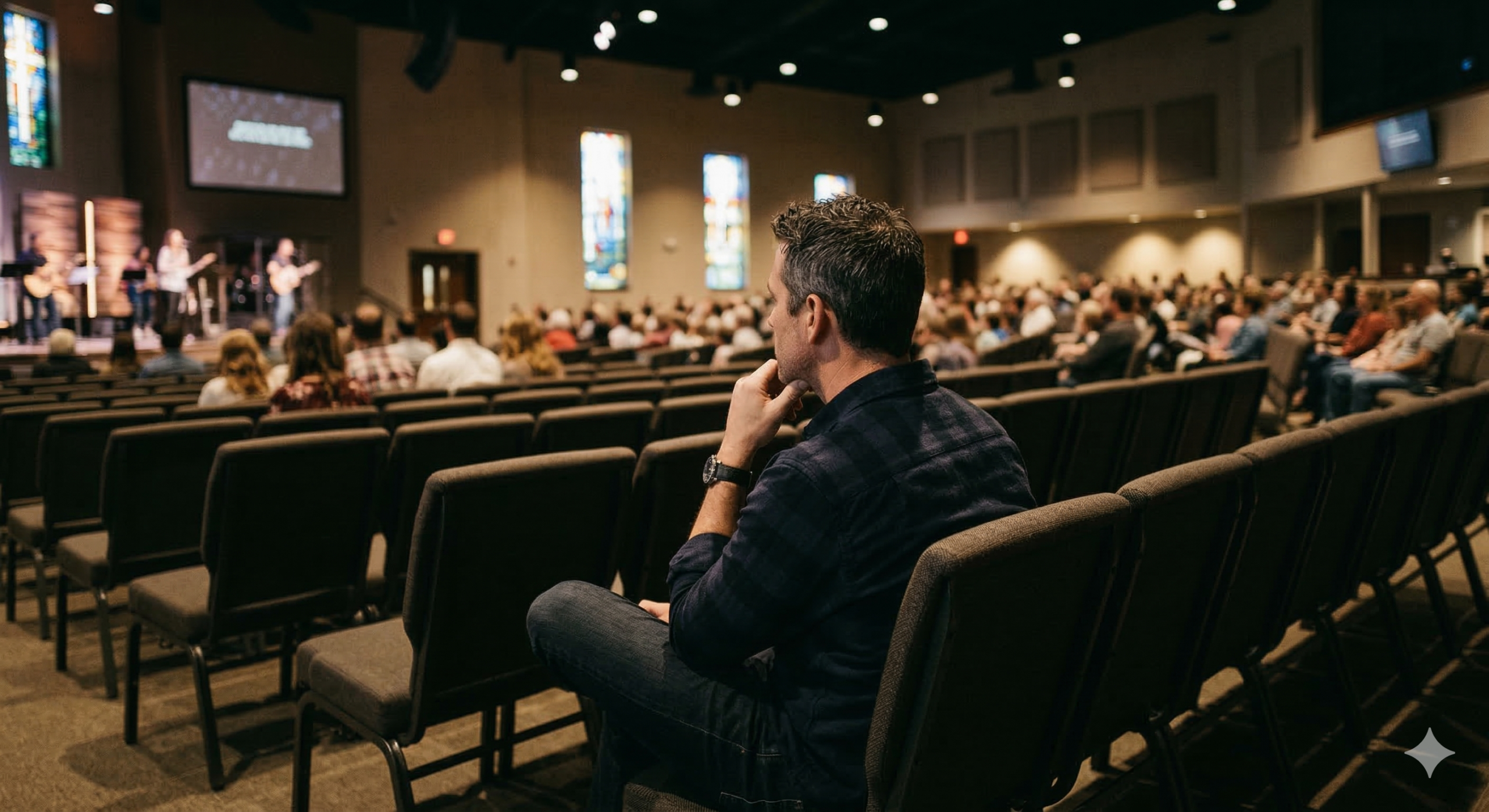
He slipped into the sanctuary with the same quietness he brought to most places now, moving down the side aisle and into the last pew on the left, the one beneath the far window where the light did not hit too hard and no one was ever forced to sit beside him unless the room was full, which it never was.
The last pew had become its own kind of arrangement with God.
Not a holy one, exactly. More like a compromise.
He was there, which had to count for something. That was what he told himself most weeks. He had made it through the front doors. He had sat beneath the Word. He had stood when everyone else stood and bowed his head when they prayed and opened the Bible when the pastor gave the text. But he had not done any of it in the easy way other people seemed to do it. Church had once felt like a place to come in and breathe. Now it felt more like walking back into a house after a fire, when the shape of everything was still familiar enough to hurt.
He set the bulletin beside him and looked down at his hands for a moment.
They looked older than he remembered. Not old, exactly, but altered. Veins a little more raised, skin a little more worn, the knuckles carrying that strange dryness that seemed to come with stress, sleeplessness, too much coffee, and not enough peace. A gold band had once sat on the fourth finger of his left hand. There had been a small pale line there for a long time after it was gone, a ghost of belonging, though even that had faded now. The hand remained, but the evidence had thinned.
The organ had not started yet. People were still settling into their pews. Up near the front, a family of five arranged themselves with the practiced choreography of people who had been doing life together for a long time. A mother bent to hand a coloring book to a little girl in white tights. The father smiled at someone across the aisle and lifted two fingers in a quiet greeting. Behind them, an older couple sat shoulder to shoulder, not speaking, but so used to one another’s presence that silence itself looked like companionship.
Daniel looked away.
He had trained himself not to stare at families in church, or at couples, or at men who rested a hand against the back of their wife’s shoulders as though marriage were still something solid and inhabitable. It was not envy exactly, though envy had lived in him often enough to be recognized. It was something heavier and more tired than that. A kind of inward shifting, as though every visible sign of shared life pressed against the part of him still trying to understand what, exactly, had been destroyed when his own marriage had ended.
People talked about divorce as though it were one wound, but it was not. It was a collapse with too many rooms in it.
There was the obvious room, the first one people thought of, the room with betrayal and arguments and lawyers and signatures and whatever particular death had finally brought the thing to an end. But there were others after that, quieter ones, that kept opening for years. The room where the bank account was split and every number suddenly looked smaller. The room where furniture had to be divided as though a life together could be measured in lamps and plates and whatever she wanted to keep from the kitchen. The room where he learned how loud an apartment could be with only one person in it. The room where he sat at the edge of a bed he had bought secondhand, staring into the blue half-light before dawn, wondering whether he was grieving the marriage, the woman, his own failure, or the man he thought he would be.
Those rooms had not disappeared. They had only stopped announcing themselves as often.
The piano began with a few soft notes, and the congregation rose.
Daniel stood too, though a second slower than the rest. The hymn was one he knew. He knew most of them, which sometimes made things worse. The familiar songs had a way of pulling old versions of himself into the room. The younger husband. The man who still believed that if he worked hard enough and prayed honestly enough and kept enough of the uglier parts of himself under control, life would eventually take on a shape that felt stable. A house. A family. Shared plans. A Christian adulthood that looked respectable from the outside and settled from within.
He had once stood beside his wife in rooms like this and sung these same words, and now he could barely get through the second verse without becoming aware of how strange his own voice sounded to him.
He sang quietly anyway.
There were some weeks when the words felt like splinters. Mercy. Faithfulness. Restoration. Covenant. The church spoke them as though they belonged to everyone equally, and maybe they did, but he had begun to hear them differently after the divorce. Not because they had become untrue, but because they had become expensive.
A pastor could say that God was near to the brokenhearted, and Daniel would believe him. He did believe him. But he also knew that there were different kinds of brokenheartedness, and not all of them felt equally welcome in church. There was the grief people understood easily, the grief that drew casseroles and cards and hands on shoulders. Then there was the kind that entered the room with too much history attached to it. The kind people did not know where to place. The kind that made them search your face for clues about whether you were the victim, the fool, the villain, or just another cautionary tale they did not have time to sort through before service started.
That was one of the lonelier parts of it. Not only being divorced, but becoming difficult to classify.
He had spent long enough in church to know how divorce was treated. In some places it was softened until it barely seemed to matter. In others it remained hanging in the air around a person like a stale odor, something never discussed directly and never fully forgotten. This church, at least, had not been cruel to him. No one had pulled him into an office and examined his failure like a case file. No one had spoken to him with the kind of polished suspicion that masqueraded as discernment. But kindness, he had learned, was not always the same thing as being known.
The song ended. People sat. The pastor stepped to the pulpit and opened his Bible.
Daniel leaned back against the pew and looked up at the light moving across the far wall. Dust drifted through it in slow, indifferent spirals, visible only because the sun happened to strike them there. It reminded him of old houses, of empty rooms, of things suspended in the air after a disturbance no one had yet cleaned up.
That was how life had felt for a long time now. Not ruined in the theatrical sense. Not shattered in a way other people could always see. More like a structure that had been stripped down past recognition, the insulation pulled out, the walls open, the wiring exposed, every private weakness suddenly visible under harsh light. There were days he thought he was rebuilding. He paid his bills. He worked. He kept his apartment clean enough. He had even tried, for a little while, to imagine what life after divorce was supposed to look like for a man who still wanted to honor God. He had wondered whether dating again would one day become possible, and every time the thought surfaced it seemed to drag three more behind it. What kind of woman would trust a divorced man? What kind of man was he now, after all of it? What did faithfulness even look like once covenant had already collapsed in your hands?
He had no answers that did not sound rehearsed.
So he came here instead, to the last pew, and sat beneath the preaching as though a man might be rebuilt simply by returning often enough to the place where truth was spoken.
The pastor cleared his throat and read the opening verse.
Daniel lowered his eyes to the page in his lap, though for a moment he could not focus on the words. All he could think was that whatever rebuilding needed to happen in his life had gone deeper than he had first imagined. It was not only a matter of recovering order, or dignity, or some clean version of the future he could live with. The life he had been trying to reconstruct had too much of himself in it. Too much effort. Too much management. Too much quiet hope that if he could make the outer things stable again, the inner man would stop feeling like a house after a storm.
But the storm had already told the truth.
And somewhere beneath that truth, beneath the shame and the long nights and the strange, humiliating smallness of starting over, another thought had been waiting for him, though he had not yet fully let himself name it.
Maybe Christ was not asking him to rebuild the old life.
Maybe Christ meant to rebuild him.
The sermon that morning was on Nehemiah, on walls torn down and a people standing in the middle of ruin, trying to understand whether the brokenness around them was only loss or also an indictment. Daniel had not read Nehemiah in months, maybe years, but as the pastor spoke, something in the language kept catching on him. Rubble. Reproach. Rebuilding. The words came with more force than they should have, as though they had passed by his life before entering the text.
He had known what it was to live among rubble.
Not only the visible kind, though there had been enough of that too. The apartment he moved into after the divorce had felt less like a home than a place where the remains of one life were stored until some other life could be figured out. A couch bought from a coworker. Two mismatched coffee mugs. A table too small for company, though no one came anyway. Half a set of plates. A closet that stayed mostly empty because he had never realized how much of the ordinary shape of a life had belonged not to him, but to the fact that someone else had once been there.
There were months when he could not tell whether he was lonely in the specific sense, or whether he was simply living inside the aftershock of having been divided from a shared existence. It was not only the marriage that had ended. It was the habits of being known. It was the logic of being expected. It was having someone to call when the car made a new sound, or when the rent was due, or when the day had gone badly enough that silence felt dangerous. Divorce did not merely remove a person. It stripped the world of its old arrangement and left behind the humiliating work of learning how to inhabit simple things again.
He remembered the first night in that apartment more clearly than he wanted to.
A lamp on the floor because he had not bought a side table yet. A pizza box folded shut in the trash. The low electric hum of the refrigerator. He had sat at the edge of the bed in his jeans and stared at the opposite wall for so long that the room itself seemed to become unreal, like the temporary lodging of a man who had misplaced his real life and was waiting for someone to return it to him.
He had cried that night, though not in the clean way people cry in movies. There was nothing cinematic about it. It was ugly and exhausted and half-angry. Not only grief over her, though there had been that too, and not even only grief over the marriage. It was the realization that whatever he had been building all those years could be dismantled more quickly than he had imagined, and that much of what he thought was solid had been far more fragile than he wanted to admit.
The pastor said something then that brought him back into the room.
“Some ruins,” he said, “are not only the consequence of what others have done to us. They are also the evidence of what we ourselves failed to guard.”
Daniel felt that line in his chest before he even thought it through.
That was part of what made divorce so hard to carry in church. If he had been able to tell the story in a way that made him clean, he might have known what to do with himself by now. If he had been the abandoned one in the simple sense, or the betrayed one without mixture, or the innocent one left sorting through someone else’s destruction, then maybe he could have built a stable identity out of that. But life had not left him such a tidy arrangement. There were things he could name in her, but there were things he had to name in himself too. Failures that had seemed survivable when they were happening slowly. Places where passivity had worn the face of peace. Places where weariness had become neglect. Places where he had mistaken the absence of open crisis for the presence of health.
He had spent enough time praying over the past to know that guilt and clarity do not arrive at the same speed.
There were years after the divorce when he told himself he was only trying to move forward, but much of what he was really doing was staying just busy enough to avoid looking directly at what had happened. He worked. He lifted weights for a while. He listened to podcasts on money and recovery and masculine discipline, most of them overpromising, all of them too clean in their language. He tried to get his footing back under him through motion. He even reached, much later, for the possibility of reconciliation, not because he believed sentiment could undo what time had done, but because some part of him needed to know whether faithfulness still required him to try.
It had gone nowhere.
That was its own kind of mourning.
The pastor kept preaching, but Daniel only caught pieces now. Not because he had stopped listening, but because the sermon had already opened something and his mind was moving inside it. He thought about the strange shame of being a divorced man in church. Not only the shame of having failed, but the shame of not knowing what category to stand in after failure. He had met men who wore their divorce like a badge of injury, and men who wore it like a quiet stain, and men who covered it with jokes, and men who disappeared from church altogether because being among intact families felt like standing too close to a mirror that reflected only what had been lost.
He had almost become one of those men.
If he was honest, there had been a stretch of time when the only thing that kept him tethered to church at all was the suspicion that outside of Christ he would become someone far worse than the man he already disliked being. He had not come back because he felt strong. He had come back because he knew that drift had teeth, and he did not trust the shape his life would take if he gave himself over to bitterness, appetite, and the kind of lonely reasoning that always sounds wise to a man sitting by himself long enough.
That was the part few people seemed to understand about divorce. It was not only sorrow. It was exposure. Exposure to self-pity. Exposure to lust. Exposure to financial strain. Exposure to the temptation to reconstruct a life out of whatever offered relief quickest. Exposure to the subtle and constant lie that if he could just meet someone else, or fix the money, or stop thinking so much, he could outrun the deeper wound.
But the wound did not move at the speed he did.
It remained where it was, waiting for him in quiet rooms.
The congregation stood for the closing prayer, and Daniel stood with them. The pastor’s voice softened as he spoke, asking God to rebuild what had been torn down, to strengthen what had gone weak, to teach His people how to live faithfully in the middle of what they had not chosen and what they had helped create. Daniel kept his head bowed, but his eyes stayed open, fixed on the grain of the pew in front of him.
That line stayed with him. What they had not chosen, and what they had helped create.
It was the most honest thing he had heard in a while.
When the prayer ended, people began moving again, reaching for coats, Bibles, children, purses, coffee cups. The ordinary machinery of post-service life started up all around him, and for a moment he thought about slipping out the way he always did, through the side door, past the little rack of missionary pamphlets and the bulletin board no one seemed to read, back into the parking lot before anyone could stop him with the kind of polite concern that made him feel both grateful and cornered.
But he stayed seated a little longer than usual.
Not because anything had been solved. It had not. The apartment would still be quiet that night. His bank account would still look smaller than it should at his age. He would still have no idea what to do with the thought of dating again, or whether a man with his history had any business imagining a second covenant when he had not yet finished understanding the wreckage of the first. All of that remained where it was.
But something in him had shifted, if only slightly. Not relief exactly. More like the first honest crack in a wall he had been leaning against.
He had spent years trying to rebuild his life by recovering structure. More discipline. More order. Better habits. A cleaner apartment. Better boundaries. The kinds of things that make a man look as though he is stabilizing. And maybe some of that had mattered. But sitting there in the thinning light of the sanctuary, with families drifting out and children laughing somewhere near the back doors, he felt the uncomfortable beginning of another thought.
The life he had lost was not coming back in its old form. He knew that now.
And if Christ meant to do something with him, it would not be a matter of restoring the old arrangement and asking him to try again with steadier hands. It would have to go deeper than that. Deep enough to reach the man who had sat on the edge of a bed in an empty apartment and realized that he did not know how to hold the remains of himself together. Deep enough to reach the shame he still carried into church every Sunday. Deep enough to tell the truth without crushing him under it.
He did not yet know what that rebuilding would require.
He only knew, with a kind of tired clarity, that Christ would have to be the One doing it.
The sanctuary had mostly emptied by the time Daniel finally stood. The piano player was gathering loose sheets of music near the front, and somewhere out in the lobby a child let out the kind of bright, uncontained laugh that only children and the deeply unashamed seem able to produce. He folded the bulletin once and slipped it into his Bible without looking at it, then moved toward the side aisle with the quiet intention of a man hoping to leave before anything became relational.
That had become its own small liturgy too. Arrive carefully. Sit in the last pew. Listen. Leave without making the loneliness visible.
He had nearly reached the back doors when he heard his name.
Not loudly. Not in the carrying tone of someone trying to secure him in place. Just enough to stop him.
“Daniel.”
He turned and saw the usher with the gray mustache coming toward him, bulletin tucked under one arm, jacket half-buttoned as though he had only just remembered he meant to put it on.
“You slipped in fast this morning,” the man said.
Daniel gave a small smile. “I’ve been refining the system.”
The usher smiled back, but not in the way people often did when they sensed something heavy and wanted to soften it with lightness. He smiled like a man who had enough years behind him to know that small jokes were sometimes just the only safe way to stand near the truth.
“Well,” he said, “it’s a poor system if it keeps getting you out the door before lunch.”
Daniel let out a breath through his nose, something close to a laugh. “I’m not much for lingering.”
“I’ve noticed.”
The older man extended his hand, though by now he had done it enough times that the formality of it felt almost ceremonial.
“Leon.”
“I know,” Daniel said. “You’ve introduced yourself every Sunday for three months.”
“And one of these weeks I’ll trust that it’s taking.”
Daniel shook his hand. Leon’s grip was dry and firm, not performative, just steady. The kind of hand that had spent a good deal of life lifting things, repairing things, keeping things running.
“My wife made too much soup,” Leon said. “Which means either I carry it home and eat it for four days, or you help me make peace with it.”
Daniel felt the old hesitation rise immediately, almost before the invitation had finished landing. It happened that fast now. Every opening in life seemed to come with two responses at once, one outward and one internal. Outwardly, he knew how to be polite, even grateful. Internally, he was already scanning for the exit. Soup meant lunch. Lunch meant conversation. Conversation meant being known at least enough to become visible. Visibility was still expensive.
He started to answer with something vague about work he needed to catch up on, though there was none, at least not work that could not wait. What he really had waiting for him was an apartment clean enough to return to, quiet enough to feel accusatory, and a Sunday afternoon long enough to make him aware again of all the places his life did not touch another person anymore.
Leon watched him with a patience that made lying feel clumsy.
“It’s just soup,” he said. “Not a testimony.”
That made Daniel laugh for real this time, brief but involuntary.
“All right,” he said. “Soup.”
Leon nodded once, as though nothing more needed to be negotiated. “Good. Margaret will be pleased to have one more person to insist he takes seconds.”
They walked through the lobby together, and Daniel immediately became aware of himself in the old way. Not because anyone was staring, but because he was no longer moving alone. The church looked different at that pace. When he came and went by himself, everything felt like background. Families clustered near the coffee station. A deacon bent down to speak to a little boy near the mission board. Two women stood off to one side with Bibles still in hand, talking in the low serious way that meant something in the sermon had followed them out of the room. A young couple with a baby carrier moved past the front doors in a rush of car keys, diaper bag, and the vaguely shell-shocked expression of people who had not slept well in months.
There was so much life in it, and that had always been part of what unsettled him.
Not because he resented it exactly. He had spent enough time trying to be truthful before God to know that bitterness was never as clean as it first presented itself. It was easy to call loneliness holiness if you stayed quiet long enough. Easy to say you were simply enduring the season you’d been given when really you were also nursing private resentments against everyone whose life still seemed to make sense in pairs and households and ordinary domestic inconveniences.
But it was also true that church had become one of the few places where he could feel both drawn in and exposed at the same time. The body of Christ was a comfort in principle. In practice, it was a hallway full of strollers, wedding bands, small talk, and an entire moral ecosystem of settled life that his own life no longer resembled.
He followed Leon out into the parking lot and stood for a moment while the older man unlocked a dark green pickup that looked as though it had outlived at least one owner and would probably outlive another.
“You need a ride?” Leon asked.
“No, I drove.”
“Then follow us. Ten minutes. White house with the porch that needs repainted and the hydrangeas my wife won’t stop defending.”
Daniel nodded.
The drive over was short enough that he had no excuse to lose his nerve and long enough that he almost did anyway.
He pulled up behind the truck and sat for a few seconds with both hands on the wheel. The house was exactly what Leon had promised, white siding, broad porch, one shutter hanging slightly crooked on the left side, and a line of winter-worn hydrangeas leaning against the front walk as though the season had taken something out of them. There was nothing grand about it. Nothing curated. It looked inhabited in the old-fashioned sense, the kind of house where things were repaired instead of replaced and where every room probably held more memory than style.
Margaret opened the front door before he reached it.
“So this is Daniel,” she said, with the strange confidence some women of a certain age have, as though there had been no possibility of him being anyone else. She was shorter than he expected, with silver hair pinned back loosely and the kind of face that looked softened by years without becoming vague. “Leon said if I made eye contact you might bolt, so I’m trying not to be overjoyed.”
Daniel smiled, a little helplessly. “That sounds fair.”
“Well, come in anyway. The soup’s already suffering.”
There was something disarming about being welcomed without being studied. Margaret did not look at him the way many church people did when they knew or suspected there was pain attached to a person. No soft extra gentleness, no searching concern, no subtle inventory of whatever wounds might require acknowledgment. She moved through hospitality the way a person moves through a house they know well, naturally, without self-consciousness.
The kitchen smelled like onions, broth, and bread warmed too long in the oven but not long enough to ruin it. A Bible lay open near the end of the table with a pair of reading glasses set upside down across the page. On the windowsill above the sink sat a row of potted herbs in different stages of success. One thriving. One yellowing. One very nearly dead.
Margaret caught him looking at them.
“Basil’s prideful,” she said. “Thinks it can live on its own terms.”
Leon hung his coat by the back door. “That’s not how plants work, Margaret.”
“That’s not how people work either,” she said, then turned to Daniel. “Sit down.”
He did.
Something about that ordinary command, sit down, loosened something in him that had been held too tightly for too long. Not because it was profound, but because it was not. No one was asking him to explain his life. No one was trying to teach him anything. No one had yet reached for the polished church phrases that made suffering sound manageable if arranged correctly. He was just there, at a kitchen table, with soup ladled into a chipped bowl and bread passed across to him by a woman who seemed to consider feeding people one of the less debatable duties of Christian life.
Leon bowed his head to pray.
The prayer was short, the kind that had long ago lost any anxiety about sounding spiritual.
“Lord, thank You for food, for this day, and for letting us gather in peace. Help us to receive what You give with gratitude and not act like we made any of it ourselves. Amen.”
Daniel lifted his eyes before the others did.
Help us to receive what You give with gratitude and not act like we made any of it ourselves.
The line settled into him more heavily than a table prayer had any right to.
Lunch moved slowly. Not because anyone was trying to create depth, but because no one was in a hurry to prove anything. Leon asked him about work, but in the ordinary way, not as an interrogation. Margaret told a story about a raccoon getting into the crawlspace last winter. Leon corrected the details. She ignored him. At some point the conversation drifted to church repairs, then to a young couple in the congregation expecting their second child, then to whether the pastor was overusing illustrations from hiking now that spring was near.
Daniel spoke less than they did, but more than he had expected to. It had been a long time since conversation felt like something that could unfold without cost.
There were still moments, of course, when his inner life pulled back and watched itself from a distance. That had become almost unavoidable. He would hear himself say something simple about work or mention the neighborhood he lived in now, and behind the sentence another awareness would rise. This is what remains. This is who you are introducing to people now. Not husband. Not homeowner. Not part of a shared life. A man with an apartment, a job, and a history people may or may not know how to hold.
He wondered if that feeling ever really left after divorce, or whether it simply became less sharp with time. The sense that every ordinary introduction carried an invisible footnote.
Margaret interrupted the thought by setting the bread basket closer to him.
“You’re eating like a man who lives alone,” she said.
Daniel looked up, startled enough to laugh. “Do I?”
“Yes,” she said. “Too carefully.”
Leon shook his head. “That means take more bread.”
Daniel did.
And because the room remained quiet enough to make honesty possible, he said, almost without planning to, “You get used to not taking much when it’s just you.”
The sentence sat there a moment after he said it. Not awkwardly. Just visibly.
Margaret’s face changed, though only slightly. Not into pity. Into recognition.
“Well,” she said, “that does happen.”
No one rushed to fill the silence after that. No one made it into a ministry moment. No one said God was teaching him something in the season or that all things work together or that Paul was single too. The quiet remained what it was, a place where something true had been said and did not need immediate repair.
Daniel looked down into his soup.
There had been a hundred nights since the divorce when he ate standing at the counter because sitting at the table made the room feel too empty. Nights when dinner was whatever required the least thought, eaten off one plate, in one chair, beneath one light. It was not hunger exactly that made those nights hard. It was the repeated confrontation with scale. How small a life could become once it was no longer shared. How many human gestures only made sense because another person was there to receive them.
He had not said any of that out loud, and he would not. Not here, not yet. But the room had shifted enough that he knew he could have, and that knowledge alone felt strangely dangerous, like the first loosened stone in a wall he had spent years pretending was load-bearing.
When lunch was over, Margaret stood to clear bowls, but Daniel rose first and gathered two without asking.
“You don’t have to,” she said.
“I know.”
She nodded and handed him another.
At the sink, with the water running hot and the afternoon light coming in thin through the window over the herbs, he had the odd thought that this was the closest thing to normal he had experienced in months. Not because it resembled his old life. It did not. There was no wife in the next room, no recovering of what had been lost, no sudden return of the shape he once thought life would keep. But there was something about the ordinariness of being folded, however briefly, into the simple life of other believers that carried a kind of steadiness he had almost forgotten existed.
Not repair exactly.
Something nearer to witness.
As though Christ had not only been waiting for him in the last pew beneath the preaching, but had also been sitting at kitchen tables all this time, in soup and prayer and unforced kindness, in the kind of people who did not know how to save a man but knew, somehow, how to stop him from disappearing.
The next Sunday he came in through the same side doors, at the same carefully chosen time, and sat in the same last pew beneath the window where the light never seemed to fall all at once. The habit still carried a trace of hiding in it, but it no longer felt entirely like retreat. Something about the previous week had stayed with him in a way he had not expected. Not only the lunch, or the soup, or the strange mercy of a kitchen table where no one had asked him to summarize his damage into something usable. It was the realization that ordinary kindness, when it arrived without performance, could expose how long he had been living as though his life were something best handled in private.
That thought had troubled him more than comforted him.
He had spent years telling himself that privacy was maturity. That there was dignity in not burdening people. That the cleanest way to live after the collapse of a marriage was to keep the mess folded inward, work quietly, pray when he could, and avoid becoming one more complicated man in the hallway of a church full of people already carrying their own lives. But privacy had not made him whole. It had only made him quieter. And there was a difference between a life that had become quiet because it was settled and a life that had become quiet because no one was allowed near enough to hear what was still breaking.
The organ started, then the first hymn, and Daniel stood with the rest of the congregation. He sang more steadily than he had the week before, though he still felt the old difficulty when certain words rose too close to things he had not yet learned how to place. Faithfulness. Covenant. Mercy. They still carried a cost. But the cost had shifted slightly now. They no longer felt only like accusations. They also felt like claims, which was harder in a different way.
That was the part of rebuilding he did not know what to do with.
It would have been easier, in some respects, to make the Christian life after divorce into a matter of recovery in the modern sense. Get the finances stable. Stop drinking too much coffee at night. Keep the apartment clean. Work out. Find a routine. Read enough Scripture to remain respectable. Learn how to mention the divorce without turning every introduction into a confession. Maybe eventually meet someone again, carefully, cautiously, in a way that did not feel unserious or desperate. Build back some version of an inhabitable life and call the whole process growth.
He had thought that was what healing would look like.
But the more he sat beneath the Word, the more unstable that definition began to feel. Stability was not the same thing as redemption. A man could become orderly and remain untouched in the deeper places. He could rebuild the visible frame of a life while the inward structure remained unsound. He could even start thinking about dating again, about companionship, about whether there might still be some future covenant left for a man with his history, and all the while still be standing on the same cracked foundation that had once failed him before.
That was what frightened him most about the thought of meeting someone again. It was not simply the fear of rejection, though that was real enough. It was not even only the question of whether he had the biblical right to move toward remarriage, though he had prayed over that long enough to know that conscience in such matters does not settle cheaply. The deeper fear was more humiliating than that. What if he was not a trustworthy man yet, even now? What if he had learned how to speak about his past more soberly than before, while still remaining, in the hidden places, too unfinished for the kind of covenant he still sometimes found himself longing for?
There were nights when that question sat with him longer than prayer did.
The apartment was always worst after dark. In daylight it could pass for manageable. A small place, but neat enough. A lamp near the couch. A framed print he had bought because the wall needed something and landscapes felt less intrusive than people. One chair at the table. One coffee cup drying by the sink. A Bible left open some mornings and closed too early on others. But night had a way of revealing scale. It took the edges off everything and left him with the proportions of the life itself. What had been reduced. What had been taken. What had been spent. What remained.
He had not realized before divorce how much of married life lived in the unnoticed middle. Not romance, not conflict, not the memorable things people tell stories about. The middle. Another person breathing in the next room. Another person reaching for a glass from the same cabinet. Another person carrying part of the rent, part of the decisions, part of the week, part of the future. When all of that was gone, the loneliness was not only emotional. It became architectural. Financial. The whole design of life altered.
There were bills he still paid slower than he wanted to because the old two-person structure was gone and had never been replaced by anything but effort. There were nights when he still felt the sharp stupidity of opening the refrigerator and finding only the sort of food a man buys when no one else is expected to eat with him. There were evenings when the silence made him aware not only of absence, but of the strange erosion of self that can happen when enough of life is carried alone for long enough.
He had not known loneliness could become procedural.
The pastor preached from 2 Corinthians that morning, and Daniel only caught the opening line before it lodged in him like a splinter.
“If anyone is in Christ,” the pastor read, “he is a new creation.”
Daniel looked down at the page in his own Bible and felt the old tension rise again, the one that had accompanied him for years in different forms. He believed that verse. He did. But belief was not always the same thing as knowing where to place yourself inside it. A new creation. What did that mean for a man who still felt followed by old ruin? For a man who knew grace intellectually, even experientially in some ways, but still carried the dull ache of consequences that had not evaporated with repentance?
That had always been one of the harder things to explain to people who spoke too quickly about new beginnings. There was a way some Christians talked that made it sound as though the grace of God should immediately erase all moral and emotional debris, as though forgiveness meant instant structural restoration, as though the old life, once surrendered, ceased to leave marks. But Daniel knew better than that. He knew conversion did not turn the past into fiction. He knew Christ forgave, but he also knew divorce left behind very real and very earthly wreckage. What he did not yet know how to hold was the possibility that Christ could still be making something new, not by pretending the rubble had never existed, but by working through it in ways he could not yet see.
The sermon moved on, but the thought stayed.
After the benediction, he remained seated longer than usual. Not because he was trying to be noticed, but because leaving had stopped feeling as urgent. The congregation drifted out in its ordinary currents, children moving faster than their parents, old friends stopping near the aisle, someone at the piano testing a hymn too softly to become a song. The sanctuary always felt different once it began to empty, less like an assembled crowd and more like a place where the truth still hung in the air after the people had moved through it.
He was still there when someone sat down two pews ahead of him.
Not close enough to force conversation. Just near enough that silence became shared.
Daniel looked up and recognized the man after a second. He had seen him before, though mostly in passing. Mid-fifties maybe, broad in the shoulders, the kind of face that looked as though life had sanded it down rather than hardened it. He wore a navy sweater and held his Bible in one hand, thumb tucked halfway through the pages as though he had meant to mark something and then forgotten what.
“You always sit back here,” the man said, still facing forward.
Daniel gave a short breath of a laugh. “That obvious?”
“Only to people who know what it is to need the back row.”
There was no pity in the line. No cleverness either. Just recognition.
Daniel looked at him more carefully then.
The man turned, not all the way, just enough.
“Thomas,” he said.
“Daniel.”
“I know.”
Daniel smiled despite himself. “Of course you do.”
Thomas nodded toward the front of the sanctuary. “Some people come to church looking for a place to belong. Some come looking for a place to hide. Sometimes it’s the same pew either way.”
Daniel felt something in him tighten and then settle. He did not answer at first, which Thomas seemed to understand as its own kind of answer.
“I sat back there for two years,” Thomas said, glancing toward the far right side. “Not because I disliked people. Mostly because I didn’t know how to stand among them after my life had come apart.”
Daniel turned his head fully now.
Thomas kept speaking in the same plain tone, the kind that made overreaction impossible.
“My wife died fifteen years ago,” he said. “Not the same thing, I know. Loss has its own species. But grief still has a way of convincing a man he’s become a category more than a person. Widower. Divorced. Alone. The word starts sitting in the room before you do.”
Daniel looked down at his hands again.
“That’s about right,” he said quietly.
Thomas rested his Bible on the pew beside him. “Church can make that worse if you let it. Plenty of whole-looking people in one room. Enough normalcy to make you feel like everyone else got the instructions you missed.”
That one landed so precisely Daniel almost laughed, though there was too much fatigue in him for it to come out as anything more than a breath.
“I keep thinking I should have more figured out by now,” he said, and the honesty surprised him even as he said it. “Not just life. Me. What comes next. What I’m even supposed to be building now.”
Thomas nodded as though none of this was new, which Daniel supposed it probably wasn’t.
“A lot of men think rebuilding means getting the visible pieces back in order,” he said. “Money steadier. Body better. Apartment cleaner. Maybe eventually another woman who helps life look inhabitable again. And there’s nothing wrong with wanting a life that’s inhabitable. But if Christ is involved, He usually goes deeper than what looks repaired from the street.”
Daniel sat with that.
The sanctuary had grown quieter. Someone laughed in the lobby, then the sound faded. A shaft of light had shifted down the far wall enough now that dust hung in it again, slow and suspended.
“I don’t even know what to do with the thought of dating,” Daniel said, before he could stop himself. “It feels presumptuous some days. Foolish on others. And then there are days it just feels impossible. Like I’m standing in the aftermath of something I still don’t fully understand, and somehow I’m supposed to know whether I’m fit to ask anyone to trust me again.”
Thomas did not answer too quickly, which Daniel appreciated more than he would have expected.
“There are men who ask that question because they’re humble,” he said after a moment. “And men who ask it because they’re afraid to be known again. Usually it’s some of both.”
Daniel nodded once. That felt true enough to sting.
Thomas turned, resting one arm along the back of the pew in front of him. “The future doesn’t have to be solved all at once. That includes whether another woman is in it. But whatever comes next, it won’t be built well if you’re still trying to recover a life that only makes sense with the old man at the center of it.”
Daniel held still.
Thomas’s voice remained low, almost conversational, but the sentence entered with more force than anything dramatic would have.
“You keep trying to rebuild what divorce took,” he said. “Christ may be trying to rebuild what divorce revealed.”
For a moment Daniel said nothing.
That was the line. Not because it was polished, but because it was true in the way truth sometimes is when it arrives before you have defenses ready for it. He had spent years grieving what had been taken, and rightly so. Years trying to reorder the practical life, years sorting through the moral wreckage, years questioning what could have been prevented, what should have been fought for sooner, what had been done to him, what he had helped create, what was still his to repent of. But beneath all of that was a quieter and more terrifying possibility. That divorce had not only destroyed a structure. It had exposed a man.
Not a fictional man. Not a cartoon villain. Just the actual one. The one with passivity in places he had called peace. The one who could hide inside work and routine and call it steadiness. The one who still wanted, even now, to be repaired visibly faster than he was being remade inwardly.
He closed his Bible and stood, not because he was finished with the conversation, but because if he sat there any longer he might say too much too quickly, and some truths needed to be carried before they could be spoken back.
Thomas stood too.
“I’m here most Sundays,” he said. “In case the back row gets crowded.”
Daniel smiled, though his throat had gone tight.
“Thanks,” he said.
Thomas nodded toward the door. “Go home. Pray honestly. Don’t rush the rest of it.”
Daniel walked out through the lobby slower than usual, past the mission board and the coffee station and the little knot of people still talking near the front windows. No one stopped him this time, and for once that did not feel like escape. It felt like permission.
Outside, the afternoon air carried the faint chill of something not fully done with winter. He unlocked his car, sat down behind the wheel, and did not start it yet.
Thomas’s words stayed with him, not loud, but immovable.
Christ may be trying to rebuild what divorce revealed.
Daniel rested his forehead for a moment against the heel of his hand and closed his eyes. The future was no clearer than it had been an hour earlier. The questions about remarriage remained questions. The apartment would still be waiting. The bills would still be there. The evenings would still lengthen in the same quiet way they always did.
But beneath all of that, he could feel the shape of something else beginning, however faintly. Not recovery in the polished sense. Not the kind where a man puts himself back together tightly enough that the world mistakes him for healed. Something slower. Less controllable. More humiliating at times, because it required him to stop managing the damage long enough for Christ to lay claim to it.
He started the car and sat a little longer before backing out.
For the first time in a long while, he was beginning to suspect that redemption might not mean being given his old life back in cleaner form. It might mean following Christ far enough into the ruins that the old life no longer remained the measure of what restoration had to look like.
That night the apartment felt the way it always did after church, only more so.
Some Sundays the quiet that followed service had a clean edge to it, almost useful, as though the silence were making room for thought. Other Sundays it settled over everything like dust, making the whole place feel smaller, flatter, and more provisional than it already was. This one was something in between. Not crushing, but close enough to the old ache that he could feel it waiting if he moved in the wrong direction.
He set his keys in the ceramic bowl by the door, a habit he had built because losing things in a one-bedroom apartment felt like proof of deeper disorganization than he could afford. The lamp by the couch was still off. The room held that blue-gray light that comes in just before evening commits itself, when objects are still visible but seem to have withdrawn a little from meaning. His coat went over the back of the kitchen chair. His Bible stayed in his hand.
For a while he just stood there.
He had never become one of those men who talked to himself in empty rooms, though there were stretches after the divorce when he understood the temptation. Not because he wanted conversation exactly, but because silence had a way of becoming accusatory when it lasted too long. It could take the shape of questions no one was asking out loud. What are you doing here? What is this life now? Is this all that remains?
He moved into the kitchen and filled a glass from the sink, standing there while the water ran cold enough to numb his fingertips. On the counter beside the stove sat the unopened mail he had not yet sorted and the grocery receipt from the day before, folded twice, then folded again. Little things. Unremarkable things. Yet some nights it seemed to him that loneliness was built mostly from little things, repeated long enough that they began to feel structural.
He carried the glass into the living room and sat on the couch without turning on the television.
That, more than anything, marked the difference between this Sunday and many others. Usually he let some kind of noise enter the room early, not because he cared much what it was, but because he had grown tired of hearing the apartment think. Sports, a podcast, a sermon he would only half-listen to, the false company of other voices passing through the dark. Anything to keep from feeling too directly the proportion of the life he was now inhabiting.
Tonight he left it quiet.
The Bible lay open in his lap, though he was not reading yet. He looked instead at the opposite wall where the framed landscape hung above the lamp table, a mountain lake at dusk he had bought from a clearance bin because it had seemed at the time like the sort of picture a man should own if he meant to look stable. He had hated it almost immediately. Not because it was ugly, but because it was so aggressively peaceful. It seemed designed for people whose lives had already arrived somewhere.
His had not.
Thomas’s words from that afternoon had followed him home like a second pulse.
You keep trying to rebuild what divorce took. Christ may be trying to rebuild what divorce revealed.
It was the kind of sentence that would have irritated him if it had come from the wrong man, or from a man who had too little sorrow in his face to speak that directly about another person’s ruins. But it had not felt invasive. It had felt exact. That was the problem.
He had spent enough years after the divorce trying to reconstruct the outer life that he could no longer easily tell where prudence ended and self-salvation began. There had been a season where every instinct in him had moved toward order. Better budget. Better schedule. Better body. Better habits. Better posture in public. He had not thought of it as vanity at the time. It had felt like survival. And some of it probably had been. A man does not walk through the collapse of a marriage and come out unchanged in his need for structure. Chaos teaches its own lessons.
But over time, that drive toward order had become crowded with other things. He had wanted not only stability, but innocence. Not only steadiness, but the ability to look at his life and find a version of himself he could respect again without having to look too long at the old failures. He had wanted progress that could be measured, because the deeper work was harder to name.
What divorce revealed.
The phrase carried more than he wanted it to.
It had revealed weakness, certainly. Passivity in moments where he should have been more awake. Fear hidden inside the posture of calm. A willingness to let things drift too long if drifting delayed conflict. A husband who could mistake the absence of disaster for the presence of health. But it had also revealed the deeper things that came after. How quickly he reached for self-protection. How easily loneliness could turn sensual in the mind before it ever became visible in the body. How often he wanted not Christ, but relief from the kind of pain that made Christ feel more necessary than useful.
He bowed his head and rubbed his thumb against the edge of the page.
It had been a long time since he prayed without trying to improve the prayer before it left him.
That had become one of the stranger losses after divorce. Not prayer itself, exactly, but the ease of it. There had once been a way he spoke to God that felt less self-conscious, less interrupted by analysis. Now even prayer sometimes arrived at the edge of his mouth with too many conditions attached. He wanted to be honest, but not too exposed. Wanted to confess, but not more than the moment seemed to require. Wanted help, but often in forms that preserved as much of his old self-direction as possible.
He thought of the nights, years earlier, when he had prayed mostly for reversal. For her to return. For clarity to come. For the marriage to become salvageable in some way he could still live with. Then later, once that road had narrowed almost beyond recognition, the prayers had changed into other forms of bargaining. Let me at least understand it. Let me not become bitter. Let me meet someone someday. Let there still be some future in which this does not define everything. Even his cleaner prayers had carried the same center. Recover what was lost. Restore the life I thought I would have. Give me a shape I can live in again.
He had rarely asked what Christ meant to expose before He rebuilt.
The room darkened by a shade.
He leaned forward and switched on the lamp. Warm light moved slowly outward across the couch, the table, the rug, and the lower half of the wall with the mountain lake. The apartment looked more forgiving under lamplight, though perhaps that was true of most things.
Daniel placed the glass on the table and looked back down at the open Bible. The text his eyes found first was not from that morning’s sermon, but from the margin where an older note had been written beside a psalm in his own slanted hand, years old now, the ink slightly faded.
Create in me a clean heart.
He stared at it until the rest of the verse rose up from memory.
Not restore to me what I had. Not return what I lost. Not remove all consequence. Create in me.
That was the prayer he had been resisting, though he had not named it as resistance until now.
Because creation implied a kind of helplessness more complete than he liked. It meant he could not merely manage the wreckage into holiness. He could not reorder his habits tightly enough to become new. He could not think his way into a clean heart. He could not rebuild the inner man by stacking enough outward improvements around him. If anything living and clean was to come out of this, Christ would have to do it.
That realization did not comfort him immediately. It undid him first.
He bent forward and rested his elbows on his knees, Bible still open in one hand, the other pressing against his forehead as though thought itself had become physically heavy.
“Lord,” he said, and the word sounded unfamiliar in the room, not because it was false, but because it had been too long since he had spoken it without preamble.
He stopped there.
No sudden eloquence came. No liturgy arranged itself. The room remained what it was, a one-bedroom apartment with a cheap lamp and a bad print on the wall and a man sitting inside the remains of a life he had not managed to repair. For a moment he considered giving up, closing the Bible, making tea, letting the night pass in its usual half-faithful way.
Instead, he tried again.
“I don’t know how to rebuild this.”
The sentence entered the room and stayed there, plain and almost embarrassingly simple.
“I don’t know what You’re asking me to carry, and I don’t know what You mean to restore, and I don’t know what’s left for me on the other side of this. I just know I can’t keep trying to make this into something I can live with by fixing the edges.”
His voice was unsteady, but not theatrical. Tired more than broken. Like a man finally too weary to keep editing himself.
“I keep thinking if I can get the outer things in order, I’ll stop feeling the collapse of it. And maybe some of that matters. Maybe it does. But I can feel now that I’m still trying to build something around myself instead of being brought low enough to let You build what You want.”
He drew in a breath and let it out slowly.
“I don’t know what to do with the shame. I don’t know what to do with the future. I don’t know what to do with the part of me that still wants companionship and the part that’s afraid I’d only carry the old man into something new if You don’t change me more deeply than this.”
That was the most honest thing he had said in months.
The room remained still. No visible answer. No alteration in the lamplight. No easing of the ache by immediate miracle. But there was, in the act of saying it plainly, a kind of release that did not feel like relief so much as surrender. The surrender of no longer trying to maintain himself as both patient and architect of his own redemption.
He turned the page and read for a while without rushing. Not to find a verse that matched the moment neatly, and not to force some emotional resolution from the text, but because Scripture had begun to feel less like a tool for getting better and more like a place where God met him without requiring that he arrive composed.
The night outside deepened. Cars passed now and then below the window. Somewhere in the neighboring building, a television flickered against a blind.
Daniel read until the words slowed him enough that the apartment no longer felt like an accusation. It was still small. Still too quiet. Still marked by aloneness in all the ways it had been before. But it no longer felt, at least for that hour, like proof that his life had narrowed beyond usefulness. It felt more like the kind of place where a man might finally stop pretending he knew how to save himself.
That, too, was not nothing.
Before bed he washed the glass, turned off the lamp, and stood for a moment in the dark living room with one hand on the back of the couch. The outline of the furniture had softened into shadow, but he knew the room by now without needing to see every line.
The thought that came to him was quieter than the others had been.
He had spent years believing that if he could just recover enough of what divorce had taken, he might one day feel whole again. A cleaner future. A clearer reputation. Better footing. Maybe even another woman, someday, if the Lord allowed it. But none of those things could carry the weight of redemption. At best, they could become part of a life rebuilt. They could never be the foundation of it.
Christ would have to be that, or nothing would stand.
He went to bed without solving the future.
But for the first time in a long while, that did not feel like failure.