



When one man stops showing up, the empty chair in the room begins to reveal more than his absence.
By the third week, the chair had stopped looking temporary.
The first Thursday it sat empty; no one thought much of it. Men missed Bible study for all kinds of reasons. Overtime. A sick kid. Traffic. A wife needing help with something at home. Nobody in the room was disciplined enough in every area of life to make punctual Thursday night attendance feel like a test of sanctification. So when Caleb did not show up that first week, Mark glanced once at the clock on the microwave above the church kitchenette, waited through the opening prayer, and told himself the same thing everyone else was already assuming. He’s late. He’ll come in halfway through, nod an apology, pour stale coffee into a paper cup, and make some small joke about work eating his life.
But Caleb never came.
The next week, his chair was still there, pulled slightly back from the folding table, a Bible study handout from the previous Thursday tucked halfway beneath one of the metal legs as though the room itself had expected him back and kept his place out of habit. Mark noticed it before anyone else arrived. He bent down, picked up the paper, looked at the neat block letters of Caleb’s handwriting in the margin beside the passage, then folded it once and set it on the windowsill above the radiator without really knowing why.
That week he sent a text around six.
You good tonight?
The reply came twelve minutes later.
Yeah man. Just buried. Be back next week.
Mark stared at the message longer than it deserved. Not because there was anything obviously wrong with it, but because Caleb had a way of sounding thinner in text than he did in person, as though some human weight got lost between the man and the screen. Still, the answer was enough to let him proceed. The others arrived in their usual staggered way, carrying jackets, Bibles, and the low-grade fatigue of men coming in from jobs, marriages, children, traffic, and all the ordinary things that made a Thursday night feel less like spiritual heroism and more like limping over the line of another week.
They opened to Ephesians. Someone made a joke about coffee that tasted like deacon repentance. Someone else asked if they were praying for Jim’s shoulder again or if that had already crossed over into accepted suffering. The room loosened the way it always did, slowly, with familiar voices filling the small classroom at the back of the church. But Mark kept glancing at the empty chair as if it might explain itself if he looked at it from the right angle.
By the third Thursday, the chair had become a presence.
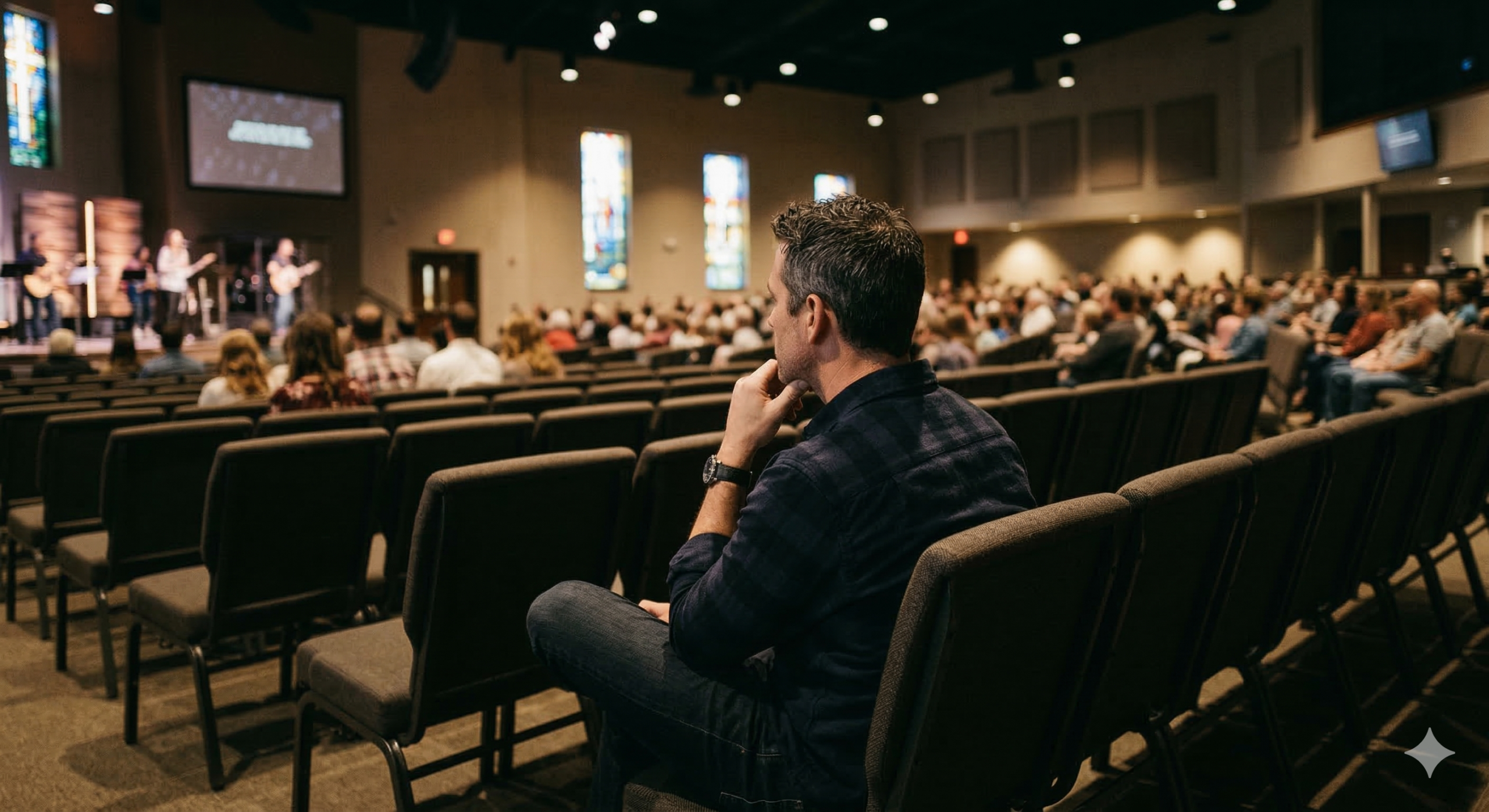
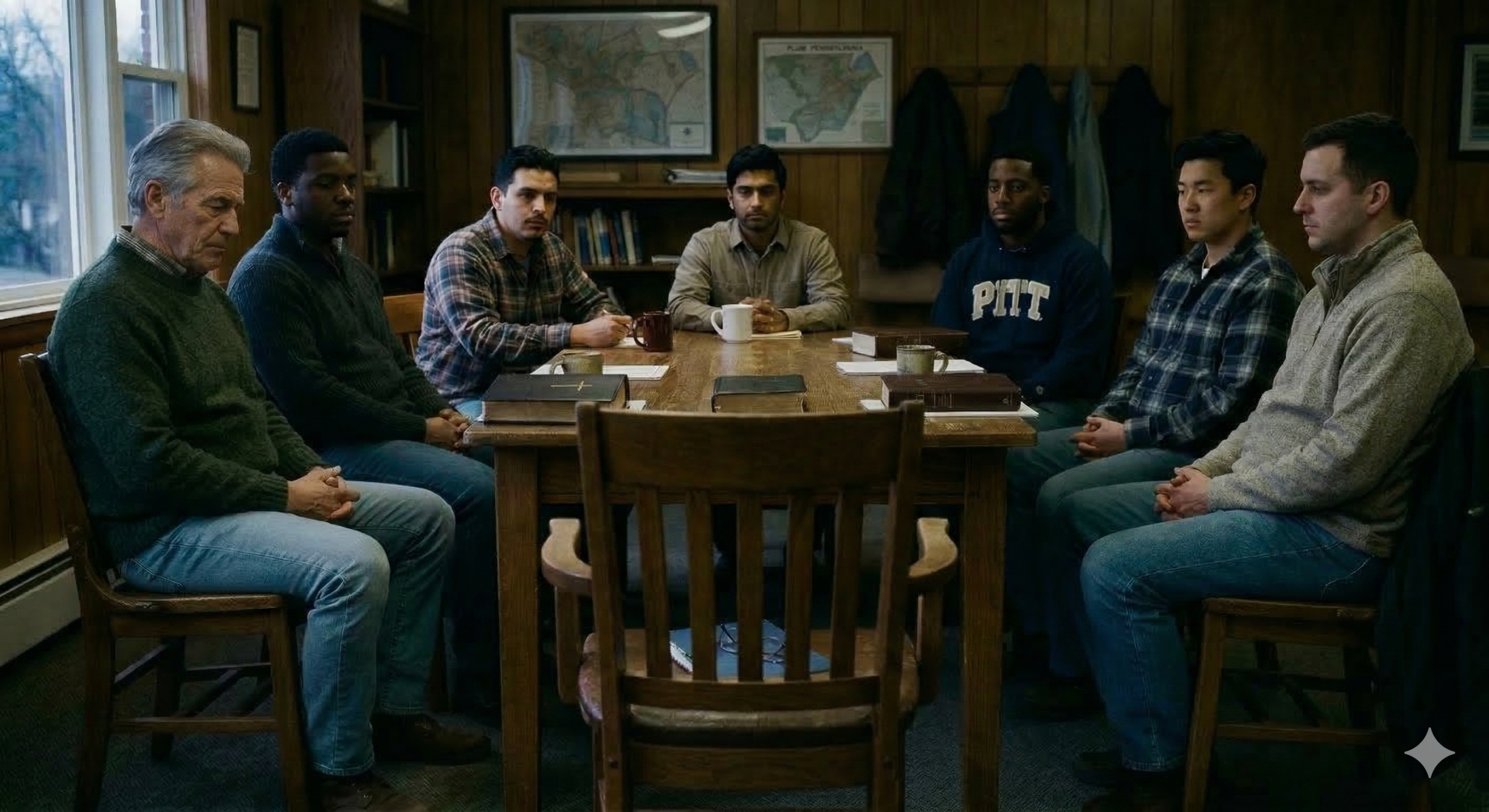
It sat on the far side of the circle near the bookshelf with the cracked plastic fern on top, angled slightly toward the table, empty in a way that made all the other chairs look occupied more than usual. Mark had almost moved it before the men came in. He had stood with one hand on the backrest and thought about folding it up, leaning it against the wall, pretending the gap did not matter. But something in him had resisted the idea. Removing it felt too close to making peace with the absence before he understood it.
So he left it there.
The men came in one by one under the hard fluorescent lights that made everyone look a little more tired than they probably were. Nathan arrived first, still in work boots, carrying his Bible under one arm and a gas station coffee the size of a paint can. Then Aaron, then Luis, then Ben, who apologized for being late when no one had asked. The room filled with the small rituals it had accumulated over the last two years, chairs scraping against the tile, lids peeling off paper cups, pages turning, jackets draped over chair backs, the familiar low murmur of men adjusting themselves from the outer world into church speech.
No one mentioned Caleb for the first few minutes. That was part of what unsettled Mark. If a man came regularly enough, and then stopped, there should have been more disturbance than that. But everyone carried on in the way decent people often do when they are not yet sure whether concern is warranted or whether mentioning a thing too early would make it awkward for no reason.
Mark opened in prayer.
“Lord, thank You for getting us here tonight. Thank You for Your Word, and for the chance to gather as brothers in a world that makes faithfulness harder than we often admit. Help us to speak honestly, listen carefully, and leave more serious about obedience than we were when we came in. Amen.”
It was a good prayer. He had learned how to pray those kinds of prayers over time, prayers sound enough to hold a room together, honest enough not to sound polished, broad enough to include whatever any of the men had dragged in with them from the week. But even as he prayed it, Mark was aware that he was looking at the empty chair in his mind.
He opened his Bible and began with the passage for the night, but concentration in the room felt slightly bent, as though some small fracture had opened in the routine and everyone was trying not to put weight on it. They were in James, talking about endurance, temptation, and the strange patience required to remain under pressure without letting pressure become permission. It should have been the kind of study Caleb had plenty to say in. He was usually one of the few men who could speak without sounding either overeager or absent. Not flashy. Not one of those men who turned every question into a sermon. But grounded enough to be useful.
Mark heard himself teaching, heard the questions he was asking, watched the men nod and talk and circle around the text, but some part of his mind kept moving backward through recent Thursdays as though the answer to the empty chair might be waiting there in plain sight now that the chair itself was there to accuse them.
Caleb had been quieter the past month. That much was true.
Not dramatically. Not enough to set off alarms in real time. Just quieter in the way men often get when life is tightening around them and they are still hoping the pressure will break on its own before anyone notices. He had started arriving later than usual, then leaving more quickly. Once or twice he had made jokes about work that landed a little too flat, as though humor had been laid over something more serious but not quite thickly enough to hide it. Three weeks ago, when the group had been talking about integrity, about who a man is when the room is empty and no one is watching, Caleb had stared down at his Bible for so long after the question came around that Mark had almost moved past him. Then he looked up, gave a short laugh, and said, “Yeah, well, some weeks I’m just asking God not to let me become someone I wouldn’t recognize.”
The room had gone quiet for a second after that.
Mark remembered laughing gently, not because it was funny exactly, but because that was sometimes how men in church gave each other permission not to explain themselves all the way. Someone else had jumped in with a story about anger on the highway, and the moment had passed. At the time, it had seemed like one of those almost-confessions men make when they are circling the thing without quite landing on it.
Now, sitting there with Caleb’s chair empty for the third Thursday in a row, Mark felt that memory differently.
Nathan was speaking, saying something about temptation not usually arriving through open rebellion but through fatigue, disappointment, and the long erosion of vigilance. The others nodded. Aaron added a thought about how men often do not fall all at once, but by letting private compromises become ordinary. Mark listened, but every sentence seemed to turn the room more sharply toward the absence they were still refusing to name.
He finally closed his Bible halfway and looked up.
“Has anybody actually talked to Caleb?” he asked.
The question sat there longer than it should have.
Luis shifted in his chair. Ben looked down at his notes. Aaron rubbed his thumb along the seam of his paper cup.
“I texted him last week,” Ben said. “He just said work was crazy.”
“Same,” Nathan said. “Couple weeks ago.”
Mark nodded slowly.
“Anybody seen him?”
No one answered.
The hum of the old radiator clicked once against the wall, then fell quiet again.
Mark leaned back in his chair and looked directly at the empty one for the first time that night, not as part of the room, but as evidence. The metal frame, the padded seat, the slight angle toward the circle as though the conversation still expected him to answer. A coffee ring from some previous week had dried into the foldout table near his spot. His copy of last month’s study sheet was still folded on the windowsill where Mark had left it.
It struck him then, with the kind of clarity that usually arrives too late to be flattering, that they had all become very practiced at accepting vague trouble from one another. Busy. Rough week. Just tired. Pray for me. Men could say almost anything if they kept it general enough, and Christian brotherhood, at least in rooms like this, often knew how to nod sympathetically without paying the cost of pressing deeper.
Mark had led this study for almost two years. He knew these men’s jobs, wives, children, favorite football teams, and recurring prayer requests. He knew who had a bad back and who worked too many hours and who was quietly worried about a rebellious son. He knew enough Scripture to carry a Thursday night discussion and enough church language to make the room feel honest.
But as he sat there staring at Caleb’s empty chair, he felt the first real sting of a thought he did not want.
It was possible to lead a Bible study for years and still not know, in time to matter, when a man was beginning to disappear.
Mark did not say that out loud, though the thought remained in the room with him after it arrived.
He looked down at the passage again and tried to recover the thread of the study, but something had shifted in the tone of it. The men still had their Bibles open. They still answered when asked. The room still looked, from the outside, like a perfectly ordinary Thursday night gathering of Christian men trying to remain faithful in a world that made faithfulness harder than it should be. But now the words on the page seemed less theoretical than they had twenty minutes earlier. Temptation. Endurance. Desire. Deception. Those things no longer lived in the abstract space where Bible studies often keep them. They had begun to lean against the walls of the room.
Luis was the one who spoke first.
“He looked rough the last time he was here,” he said, not looking up from his Bible when he said it, as though the admission embarrassed him. “I thought it was just work, but I remember thinking he looked like he hadn’t slept.”
Nathan nodded slowly. “He’s been saying work was bad for a while.”
“That’s not unusual,” Aaron said. “Everybody says work is bad.”
“Yeah,” Luis said, “but I think with him it wasn’t just a thing to say.”
Mark watched the men as they spoke. None of them sounded dramatic. No one was reaching for the pleasure some people seem to take in becoming suddenly serious once trouble becomes likely enough to be discussable. It was something sadder than that. They were all reaching back through recent memory and discovering, one small detail at a time, that they had seen more than they realized and understood less than they should have.
Ben leaned forward in his chair, forearms on his knees.
“Three weeks ago,” he said, “after everybody left, he stayed back for a minute. Not long. Maybe thirty seconds. I thought he was going to say something.”
Mark looked up.
“What kind of something?”
Ben shook his head. “I don’t know. He just stood there near the coffee table, looking at the floor, and I asked if he was all right. He said, ‘Yeah, just one of those seasons,’ and then he smiled in that way people do when they’ve already decided you’re not getting anything else.”
Mark remembered it then. Not the moment itself, but Caleb leaving later than usual that night. Mark had been stacking handouts and wiping rings off the foldout table with a paper towel that only moved the stain around. He had registered the delay without letting it become a question.
“What did you think he meant?” Mark asked.
Ben gave a tired sort of half laugh. “Honestly? I don’t know that I thought much of anything. I figured if he wanted to talk, he would.”
The sentence landed harder than it should have.
Mark knew it was not indifference. That was what made it uncomfortable. It was the kind of assumption good church men make all the time, often because it feels respectful. If he wants to talk, he will. If it’s serious, he’ll say more. If he needs help, he knows we’re here. The whole arrangement rests on the belief that people in real trouble will eventually become clear enough to rescue. But that was not how many men unraveled. They did not come into the room with disaster written on their faces. They came in more tired. More distracted. More vague. They laughed a little too quickly. They answered prayer requests a little too generally. They sat in the same chair and let everyone believe that sitting in the chair still meant they were intact.
Nathan broke the silence.
“I saw him outside Home Depot two Saturdays ago,” he said. “He was loading something into the back of his truck, and when I asked how work was going, he said, ‘Still employed, by the grace of God,’ but he said it weird. Too sharp. Like he wanted it to sound like a joke, but it wasn’t one.”
Luis looked over. “You didn’t say that last week.”
Nathan shrugged, but his face had tightened. “I didn’t think it meant anything last week.”
“That’s the problem,” Mark said, before he meant to.
The room quieted again.
He looked at the open pages in front of him, then closed the Bible fully this time and set both hands on it. The gesture felt heavier than it should have, as though he were admitting by it that the study, at least in the form he had planned, was no longer happening.
“That’s the problem,” he repeated more quietly. “Everything means nothing until it means something.”
No one argued.
The old fluorescent lights buzzed faintly overhead. The radiator clicked once more and then gave up. A car door slammed somewhere outside the building, followed by the brief wash of headlights moving across the lower part of the classroom blinds before vanishing again.
Aaron sat back in his chair.
“I called him Monday,” he said. “Didn’t pick up. I left a voicemail, but I kept it casual. Didn’t want to sound weird.”
Mark almost smiled, though there was nothing funny in it. “We’re a room full of men trying not to sound weird while one of our own disappears.”
That line might have sounded sharper than he intended, but no one recoiled from it. If anything, it seemed to relieve something. The air in the room had been too full of carefulness for too long.
Luis rubbed his hands together slowly.
“You think it’s something bad?” he asked.
Mark did not answer right away.
That was the question beneath everything now, and he knew enough about men, and about himself, to know there were a hundred ways to answer it falsely. You could answer too quickly and sound like a gossip. Too cautiously and sound like a coward. Too spiritually and hide inside phrases that cost nothing. He did not want to do any of those things.
“I think something’s wrong,” he said at last. “I don’t know what kind of wrong. But I don’t think this is just overtime and a busy month.”
Ben exhaled and looked over at the chair.
Caleb’s chair.
It had already become that in the room, though no one had said it. Not just an empty folding chair pulled up near the table, but his place in the circle, his absence now taking on shape because the shape he used to occupy remained. Mark followed Ben’s gaze and thought again about moving it, about removing the physical reminder that one of them was missing. But now the thought felt worse. Cowardly almost. Like closing a Bible before the hard part of the passage.
He stood and walked to the windowsill, picked up the folded handout from the previous week, and opened it. There was not much on the page, just the printed passage and a few notes in Caleb’s blunt, slightly slanted handwriting. One line in particular had been underlined twice.
each person is lured and enticed by his own desire
Mark stared at it.
“What passage were we in the last time he came?” he asked.
James, obviously. Same as tonight. But now he wanted to know not only what text they had read, but where exactly they had stood when Caleb sat in that chair and let the words move through the room without saying what they were already touching.
Ben flipped back through his pages. “James one. Temptation. Desire. Sin leading to death.”
Aaron made a low sound through his nose, not quite a sigh.
“Well,” he said, “that’s not ideal.”
Mark ignored the phrasing and kept looking at the sheet.
Something in him had begun to gather itself, not into certainty, but into direction. That was usually how these things worked. Clarity did not arrive all at once. It accumulated around enough small facts that the old explanations no longer held together. A missed week. Then another. Then another. A thinner voice in text. A joke too sharp to be a joke. A man staying after as though he meant to say something and then not saying it. A line underlined twice in a study on temptation.
He turned back to the room.
“Did anybody know if work was actually in trouble?” he asked.
The men exchanged the kind of glances that meant pieces were starting to emerge from different corners without yet forming a whole.
Luis spoke first. “My wife said Caleb’s wife mentioned they were trying to cut back on everything.”
Mark looked up. “When?”
“Couple weeks ago. Maybe three. She didn’t make it sound like crisis. More like one of those ‘things are tight, pray for us’ kind of conversations.”
Nathan frowned. “He told me in January they had some clients pull out. I thought he meant the company, not him personally.”
“What kind of work was he doing again?” Ben asked.
“Project management,” Aaron said. “Commercial stuff.”
Mark nodded slowly. He knew that already, but now he was listening for something else. Not facts alone. Fracture lines.
Financial pressure made sense. More than sense, really. It fit too neatly with the change they had all half-noticed and half-dismissed. There was a particular way pressure moved through a man when provision began to feel unstable. Mark had seen it in others. Had felt forms of it himself in leaner seasons. Money was never just money, not for most men. It reached into identity too quickly. Usefulness. Security. A man could lose ground financially and find that far more than numbers had started to tremble.
And when a man’s sense of steadiness began to go, he did not always collapse where other people could see it first.
The room had gone quiet again, but it was a more active quiet now. Not avoidance. Reckoning.
Mark set the handout down on the table in front of Caleb’s chair and looked at the men around him. They all looked older under those lights than they had when the night began. Not aged exactly. Just stripped of the casualness they had walked in with.
“I think we need to go find him,” he said.
No one objected, but no one answered immediately either. The sentence had weight, and they all knew it. Bible study could remain Bible study as long as concern stayed in the room as a topic. Going after him changed the kind of night it was.
Aaron was the first to speak.
“You mean tonight?”
Mark looked at the clock on the wall. A little after eight-thirty.
“If we don’t mean tonight,” he said, “we probably don’t mean it yet.”
That one sat heavily, but not unfairly.
Nathan rubbed the back of his neck. “You think he’d even answer the door?”
“I don’t know,” Mark said. “But there’s a point where not wanting to intrude becomes a way of protecting ourselves from having to do something costly.”
Ben leaned back and let out a slow breath. “I can go.”
Luis nodded. “Me too.”
Mark looked at them, then at the chair again.
For all the years he had been leading this room, he had thought the real work was keeping men coming, keeping the Word open, keeping the conversation moving, keeping the awkwardness level low enough that no one stopped showing up out of sheer social fatigue. There was some truth in that. Men did need rooms like this. They needed Thursday nights, open Bibles, ordinary prayers, and other men trying, however imperfectly, to remain faithful. But sitting there now, with Caleb’s empty chair turned into the center of the room by the force of his absence, Mark felt how incomplete that understanding had been.
A Bible study could not merely be a place where men said true things in one another’s presence.
At some point, if it meant anything, it had to become the kind of room from which men were willing to stand up and go after the brother who had stopped coming before he disappeared entirely.
Mark reached for his phone.
“I’ll call first,” he said. “Then we’ll go.”
He scrolled down to Caleb’s name and pressed it. The men sat without speaking while it rang. Once. Twice. Three times. Then voicemail.
Mark did not leave a message right away. He listened to the beep, felt all the easy false versions of concern rise up in him, the casual tone, the no pressure, just checking in, give us a shout when you can. Every sentence that would make the call safer for the caller than for the one receiving it.
He waited a second longer and spoke plainly instead.
“Hey, Caleb. It’s Mark. We’re just wrapping up Bible study. We miss you, and I don’t think this is just busyness anymore. I’m heading your way with a couple of the guys. You don’t have to have yourself put together. Just be home.”
He hung up.
No one in the room said anything after that.
The chair remained where it was, still empty, but now something had changed. It no longer felt like a quiet accusation left in the room to haunt them after the study ended. It had become a question they were finally willing to follow out the door.
The drive over was quieter than Mark expected.
Luis rode with him. Ben followed behind in his own car, headlights moving in and out of the rearview mirror as they made their way through the older part of town where apartment buildings stood shoulder to shoulder in a kind of tired practicalness, as though they had long ago given up trying to be attractive and settled for remaining useful. The streets were wet from an earlier rain, not enough to reflect the whole city back at itself, just enough to catch the orange glow of streetlights in broken patches along the curb.
For the first few minutes no one said anything. The radio stayed off. Mark drove with both hands on the wheel, eyes forward, feeling the weight of what they were doing settle into the car more fully now that the room at church was behind them. Bible study had its own kind of protection. Even difficult conversations could remain partly abstract there, softened by chairs in a circle, open Bibles, and the familiar cadence of Christian men speaking about hard things in the safe grammar of theology. But a drive like this stripped the distance out of concern. They were no longer discussing a brother’s absence. They were going to see what that absence had become.
Luis was the one who finally spoke.
“You think he’ll open the door?”
Mark kept his eyes on the road. “I don’t know.”
“He might not want us there.”
“That’s probably true.”
Luis nodded once and looked out the passenger window. “I’m just trying to figure out the line between pursuit and making a man feel cornered.”
Mark understood that. It was one of the reasons men left each other alone so often. Every serious act of care came wrapped in the risk of being unwelcome. Nobody wanted to be the one who crossed the invisible boundary, the one who turned concern into pressure, or made private pain feel surveilled. Men, especially Christian men trying to remain decent, could become so careful about respecting space that they ended up standing politely on the edge of another man’s collapse.
“I think if he was doing well,” Mark said after a moment, “we wouldn’t be in the car.”
Luis let out a breath through his nose, not quite a laugh.
“That’s fair.”
They drove another block in silence. Mark’s phone sat dark in the cupholder. Caleb had not called back. Had not texted. Had not sent the kind of thin reply that left everyone technically less worried while changing nothing.
Ben’s headlights turned with them into the parking lot of a low brick apartment building with narrow balconies and a row of mostly identical doors facing a patch of dead winter grass. Caleb lived on the second floor, end unit, right side. Mark knew because Caleb had hosted the Bible study there once, nearly a year earlier, back when his wife still sat in the living room some Thursdays with a book in her lap while the men crowded around the kitchen table and pretended not to notice that marriage was one of those things that still seemed natural in the room.
The parking lot was half full. Caleb’s truck was there.
Mark pulled into a space two spots down and turned off the engine. The three men sat in the pause that follows arrival but precedes commitment, that small human delay before doors open and private concern becomes visible action.
Ben came up to the driver’s side window and Mark lowered it.
“He here?”
Mark nodded toward the truck. “Looks like it.”
Ben glanced up at the building. One lamp glowed behind the blinds of the second-floor end unit, dull yellow and low. Not bright enough to look inhabited warmly. Just proof of electricity and someone not yet asleep.
Luis unbuckled. “All right, then.”
They went up together.
The metal steps gave slightly beneath their weight, the rail cold enough to make Mark pull his hand back instinctively when he touched it. Up close, the building carried the smells older apartments always did, damp drywall, stale heat, someone’s laundry detergent leaking faintly into the hall, and beneath all of it the tired neutral scent of people living too close together and trying to keep their private lives from touching.
Caleb’s door was shut. Light showed beneath it in a thin strip.
Mark knocked.
Not too hard. Just enough for someone inside to hear and decide whether hearing would become answering.
Nothing.
He knocked again, this time with the flat of his hand.
Still nothing.
Luis shifted beside him and looked down the narrow hallway. Ben stood slightly back, hands in his coat pockets, eyes fixed on the door with the careful expression of a man already bracing against what he might see.
Mark knocked a third time.
There was movement then, slight but unmistakable. Not footsteps exactly. More the sound of someone stopping what he was doing and standing still enough that the apartment itself betrayed him.
Mark leaned forward a little, not raising his voice much.
“Caleb. It’s Mark.”
Silence.
Then, from inside, something set down on a hard surface. A muted scrape. The soft thud of a step taken reluctantly.
Mark waited.
When the lock turned, it did so with the slow resignation of someone who had already run through the other options and found none of them survivable.
The door opened halfway.
Caleb stood there in a gray T-shirt and dark sweats, one hand still on the knob, the other hanging loose at his side as though he had forgotten what it was for. He looked thinner than Mark remembered. Not dramatically, just enough that the change registered all at once in his face. His beard had grown unevenly, not in a deliberate way, but in the way of a man who had stopped caring whether he looked as tired as he felt. There were deep shadows under his eyes, and his eyes themselves carried that particular drained alertness of someone who had not been resting even when he was technically sleeping.
For a second no one spoke.
Caleb’s gaze moved from Mark to Luis to Ben, then back again.
“You actually came,” he said.
The sentence held more than surprise. There was fatigue in it. Something close to irritation. And beneath both, something else that looked too much like relief for him to want it seen.
Mark did not smile.
“Yeah,” he said. “We did.”
Caleb kept one shoulder angled against the door as though his body had not yet decided whether this was a conversation or a refusal. Behind him, Mark could see only the edge of the kitchen counter and the corner of a lamp in the living room, the light low and yellow and somehow making the whole apartment look more tired than dark.
“I was going to call you back,” Caleb said.
Mark nodded once. “Maybe.”
The hallway stayed quiet around them. Somewhere farther down the building, a television laughed too loudly at something none of them could hear.
Caleb glanced down the hall, then past them toward the stairs, then back into the apartment. It was the look of a man cornered not by force but by the sudden collapse of distance. Mark knew it because he had worn it himself in other years and under different kinds of exposure.
“You guys don’t have to do this,” Caleb said.
There it was. The instinctive offering of escape. For them as much as for him.
Luis spoke before Mark could.
“We’re already here.”
Caleb looked at him and then gave the smallest shake of his head, not in disagreement exactly, more like disbelief that the ordinary barriers had failed him. The vague texts. The missed Thursdays. The promise to be back next week. All of it had bought him less time than shame had hoped.
Mark kept his voice even.
“You going to let us in?”
Caleb’s face changed slightly at that. Not because the question was harsh, but because it was plain. No false casualness. No pretending they had only happened to be in the neighborhood. No giving him one more polished ramp off the moment.
For a few seconds Mark thought he might still say no.
Instead, Caleb stepped back.
The apartment told the first part of the story before he did.
It was not filthy. That would have been easier in some ways, because obvious disorder gives everyone something external to point at. This was worse in the quieter way real unraveling often is. The place looked maintained by a man with just enough energy to keep things from turning into spectacle and not enough to keep them from saying something anyway.
Mail covered one end of the counter in a slanted stack, some envelopes opened, others still sealed, one red notice half-hidden beneath a utility bill. A laptop sat open on the kitchen table beside a yellow legal pad filled with job listings and numbers crossed out hard enough to crease the paper beneath. Two coffee cups, both unwashed, stood near the sink. A dish towel hung from the oven handle, damp and sour-looking, as if it had been there too long. On the arm of the couch lay a Bible facedown, pages bent slightly under its own weight, not neglected exactly, but not living in use either.
There was something in the room that felt less like chaos than constriction. Life narrowed by pressure. Air thickened by private thought.
Ben closed the door behind them.
Nobody rushed to sit. Nobody made a joke. Caleb remained standing near the kitchen counter as though sitting down would imply more permanence than he could handle. Mark took in the apartment the way men do when they are trying not to look like they are taking in the apartment.
Caleb noticed anyway.
“It’s not as bad as it looks,” he said.
No one answered that.
After a moment Luis reached for one of the dining chairs and pulled it out just enough to sit, quiet and unceremonious. Ben leaned against the wall near the door. Mark stayed standing.
“How long ago did you lose the job?” he asked.
Caleb’s jaw tightened. Not because the question surprised him, but because it landed too close to the center too soon.
He looked down at the legal pad on the table, then at the red notice sticking from beneath the pile of mail, as though the room had betrayed him more efficiently than he had expected.
“Five weeks,” he said.
The number hung there.
Five weeks.
Five Thursdays. More than enough time for a man to disappear from the room while everyone still told themselves he was just buried.
Mark felt something low and sober move through him. Not anger. Not even shock. Just the sad finality of a guess becoming fact.
“Why didn’t you say anything?” Ben asked, and then seemed to regret the sharpness of it as soon as the words left him.
Caleb looked at him, tired more than defensive.
“Because I was going to fix it.”
Nobody moved.
“I thought I’d have something lined up in a week,” Caleb said. “Maybe two. I had some interviews, some leads, some money still sitting there. I thought if I just tightened everything up and kept my mouth shut, I could get ahead of it before it turned into a whole thing.”
Mark glanced again at the bills.
“And when it did become a whole thing?”
Caleb gave a short laugh that held no humor in it.
“You want the Christian answer or the real one?”
“The real one.”
Caleb ran a hand across the back of his neck and looked at the floor.
“The real one is that I got scared,” he said. “Then I got ashamed that I was scared. Then I got tired of hearing my own thoughts. Then I stopped wanting to sit in a room full of men talking about faithfulness and self-control and trusting God while I was going home every night wondering how long it would be before everything cracked open.”
Luis leaned forward slightly in his chair, elbows on his knees.
“Is your wife still there?”
Caleb was silent long enough that the answer came before the words did.
“No,” he said. “She went to her sister’s four days ago.”
That shifted the room again.
Not dramatically. Just enough that the air seemed to settle lower.
Mark chose his next words carefully.
“Because of the money?”
Caleb’s face tightened in a way that made clear the answer was more complicated and more humiliating than that.
“The money started it,” he said. “Or maybe it exposed it. I don’t know anymore.”
He sat down finally, but only on the edge of the chair, forearms resting on his thighs, palms hanging loose between his knees. It was not the posture of a man preparing to defend himself. It was the posture of someone too tired to hold the structure upright much longer.
Mark waited.
Caleb looked toward the dark television screen across the room, as though it were easier to tell the truth at an angle.
“I lost the job,” he said, “and it felt like something in me just gave way faster than it should have. Not only the fear, though there was plenty of that. Something worse. I started feeling like everything I’d been saying about trusting God was only true as long as my life still looked stable enough to support it. And once that started cracking, I…” He stopped and pressed his fingers against his mouth for a second. “I went back to old things.”
No one interrupted him.
He took his hand away.
“At first it was just the old stupid logic. One bad night. Just trying not to think. Just trying to shut it off long enough to sleep. But you know how that goes. Once shame has somewhere to live, it starts furnishing the room.”
The words entered quietly, but they did not need volume.
Mark felt Luis shift in the chair. Ben looked down.
Caleb kept going, because at that point there was no graceful way to stop halfway.
“It got ugly fast,” he said. “Not because I suddenly turned into some cartoon version of myself. Just because I knew exactly what I was doing while I was doing it and kept doing it anyway. The job stuff got worse. The bills got tighter. I stopped talking. She knew something was off. Then she found it.”
Mark did not ask what specifically she found. The room did not need that level of detail to understand the devastation.
Caleb stared at the floor between his shoes.
“I told myself I’d come back when I had myself under control,” he said. “That was the plan every Thursday. Get through one more week. Stop. Clean it up. Get another interview. Be able to sit in the room without feeling like every verse had my name on it. I kept thinking if I could just fix the worst of it first, then I’d come back and nobody would have to know how bad it got.”
He let out a breath that sounded almost like a cough.
“But it turns out disappearing isn’t the same thing as repenting.”
That was the truest thing anyone had said all night.
Mark let the sentence sit where it landed.
No one in the room moved to soften it. No one rushed to say that everybody struggles, that grace covers, that things can be rebuilt. All of that might eventually be true in the right order, but spoken too early it would have sounded less like mercy and more like a man trying to get out from under the full weight of what he had finally admitted.
The apartment had gone very still.
Outside, somewhere below the second-floor window, a car door shut and an engine turned over, then faded into the wet night. The sound came and went without changing anything in the room. Caleb remained bent forward in the chair, forearms on his knees, looking like a man who had finally stopped trying to hold his body in a way that suggested stability. The fatigue in him was not only physical. It was the deeper exhaustion of secrecy, of keeping one part of life upright by letting another part rot in silence.
Mark had seen that before in smaller forms, though never close enough to feel responsible for it. Men carried private fractures all the time. Lust. Debt. Fear. Anger. Resentment. Weariness that turned into a thousand low compromises. Most of it never announced itself dramatically. It moved under the skin of ordinary life, wearing the face of stress, busyness, bad weeks, unanswered texts, and one more missed night that was always explained in terms just vague enough to preserve the illusion that the man still had hold of the wheel.
That was what made this room feel so heavy. Not simply that Caleb had fallen back into porn, or that he had lost the job, or that his wife had left for her sister’s house. It was that all of it had been happening while the study went on. Bibles open. Coffee poured. Prayer requests offered. Men nodding along to the truth while one of them was already half gone.
Mark pulled out the chair beside Caleb and sat down.
He did not sit across from him like a counselor. He did not turn his body square and make the moment feel clinical. He just sat close enough that the distance in the room changed.
“You should have told us,” he said.
It was not accusation. Not exactly. It carried grief more than anger, and that seemed to Caleb be worse in some way, because his face tightened and he nodded without lifting his eyes.
“I know.”
Mark looked at the legal pad on the table, the crossed-out jobs, the numbers written and rewritten, the small arithmetic of a man trying to buy himself one more week of appearing fine.
“What did you think we were going to do?” he asked.
Caleb gave a thin, tired smile that did not reach his face.
“That depends which version of you I imagined.”
Mark almost smiled back, but there was too much sadness in the room for it to land.
“Fair enough.”
Caleb leaned back a little then, not into comfort, but into the kind of surrender that comes when there is no energy left to keep crouching around the truth.
“I didn’t want to be the guy who had to say he was failing in every direction at once,” he said. “Losing work is one thing. Men know what to do with that. You tighten up, get serious, make calls, pray for provision, keep moving. But once it got mixed with this…” He gestured vaguely toward the room, toward himself, toward the shape of what he had admitted. “I didn’t know how to come in and talk about temptation like it was a category when it had already turned into the place I kept running back to.”
Luis, still leaning forward in the chair, spoke quietly.
“You didn’t have to talk about it like a category.”
Caleb looked over at him, and something in his face flickered. Pain, maybe. Or the first hint of how much easier that sentence would have been to hear six weeks ago.
“No,” he said. “I guess I didn’t.”
Ben had remained near the wall this whole time, but now he stepped closer and rested one hand on the back of an empty chair. His voice came out lower than usual, stripped of the easy inflection he often used to keep things from getting too tense.
“I keep thinking about all the times you said enough that one of us should have pushed harder.”
Caleb shook his head almost immediately.
“That’s not on you.”
“It’s not not on us either,” Ben said.
Mark looked at him then, and Ben held the look without backing off.
That was one of the more difficult truths in rooms like this. Personal responsibility remained personal responsibility. Caleb had hidden. Caleb had chosen. Caleb had gone back to what he knew would numb him and then had chosen darkness over confession because shame always prefers to become private before it becomes repentant. None of that could be shifted onto the group.
And yet.
There was still a way of loving one another so cautiously that it became negligence wearing manners. There was still a way of honoring privacy that slowly turned into a structure where everyone could stay hidden as long as they kept their answers polished enough to survive the room. The men around this table had not caused Caleb’s collapse, but they had all participated in a version of brotherhood too easily satisfied with partial visibility.
Mark felt that plainly now.
He looked at Caleb again.
“Disappearing wasn’t repentance,” he said.
Caleb nodded once, eyes still lowered. “I know.”
“It was shame trying to get you cleaned up before anybody saw how deep it went.”
This time Caleb did not nod right away. He pressed both hands together between his knees and stared at them for several seconds before answering.
“Yes.”
The apartment seemed to hold that answer in place.
Mark thought of the line from James still sitting on the table at Bible study, underlined twice in Caleb’s handwriting. Each person is lured and enticed by his own desire. The verse was true, painfully so. But another truth was pressing against it now too. Sin isolated. Shame concealed. And men, even Christian men with open Bibles and good intentions, often let each other vanish one vague answer at a time.
Luis looked toward the kitchen counter, where the mail sat in its tilted stack.
“Do you have enough to get through the month?” he asked.
Caleb gave a tired laugh. “That depends on how much month we’re talking about.”
Luis did not laugh.
“I’m serious.”
“I know.”
Caleb rubbed his forehead and looked around the room for the first time since they had come in, not really at them, more at the apartment itself, as though seeing it with other people in it made it harder to keep pretending it was still temporary. The bills. The legal pad. The cold light from the lamp. The Bible on the couch with its bent pages. The shape of his life had stopped being private the moment they stepped through the door, and there was no easy dignity in that. But Mark could also see, in the slackness beginning to enter Caleb’s shoulders, that some burden had become very slightly less solitary.
“My wife’s not answering much,” Caleb said after a while. “I don’t blame her. I told her I’d stopped. I said all the right things, and then when the pressure hit, I went right back to the place I used to run to before I even knew Christ. It felt… familiar in the worst way. Like something old in me was waiting for a bad enough week to prove it wasn’t actually dead.”
Mark listened without interrupting.
That was the kind of sentence Bible study rooms rarely heard spoken plainly enough. Not because men did not know what it was to carry old patterns, but because most confessions stayed just general enough to preserve image. I’ve been struggling. Pray for discipline. The week’s been hard. All true, usually. And all often too cleaned up to force real entry into the light.
“What do you want to do now?” Mark asked.
Caleb looked up then, and for the first time since they arrived, there was something like anger in his face. Not at them. At the question itself.
“I don’t know,” he said. “That’s the problem. I want ten different things at once. I want the job back. I want my wife back. I want to not be this man. I want to wake up tomorrow and feel like I’m not carrying around a private landfill in my chest. I want to be able to walk into church without feeling like every verse is aimed at me personally.”
His voice had sharpened, but only because exhaustion was stripping it of control.
“And I know what the right answers are,” he went on. “Repent. Bring it into the light. Trust God. Fight sin. All of that is true. I know it is. But right now the whole thing just feels like standing in the ruins of myself with a Bible in one hand and no idea where to put the other.”
No one in the room tried to correct the language.
Because if Mark was honest, it was the clearest thing Caleb had said all night.
Ben pulled out the chair by the wall and sat down at last.
“You don’t have to figure out the whole future tonight,” he said. “You do have to stop acting like getting yourself fixed in private is the first step.”
Caleb looked over at him. His face had lost some of its defensiveness now, but in its place was something almost harder to look at. A kind of exposed grief.
“I didn’t want to sit in that room and lie anymore,” he said quietly.
Mark nodded.
“Then don’t.”
The answer was so simple it almost sounded cruel, but the room heard the difference. Mark was not saying the road ahead was simple. He was saying the next step was. Stop disappearing. Stop postponing light until you feel worthy of it. Stop treating private repair as repentance.
Caleb stared at him for a long second, then looked away.
“What if I come back and I’m still a mess?”
Mark glanced toward the door, as if he could still see the room they had left behind, the folding table, the Bibles, the coffee, the empty chair that had finally become too loud to ignore.
“Then you’ll be a mess in the room instead of a mess alone in the dark,” he said. “That’s a better place to start.”
No one said anything after that for a while.
Eventually Luis stood and moved toward the counter, found four mismatched mugs, rinsed them without asking permission, and started coffee with the sort of ordinary confidence that belongs only to men who have decided they are staying longer than politeness requires. Ben gathered the bills into a neater stack, not to pry, just to keep them from looking like the apartment itself had surrendered. Mark remained where he was, seated beside Caleb, not speaking, not pressing, simply refusing to leave him alone with the whole thing again too quickly.
That was when Mark understood, more clearly than he ever had in the Bible study room, that Christian brotherhood was not proven by how easily men could discuss truth when seated in a circle with enough coffee and enough light. It was proven here, in the bad apartments and the ruined weeks and the unedited admissions, in the willingness to sit with a man after his shame had already become visible and not step back from him.
He had thought, for longer than he wanted to admit, that leading men meant keeping the room open, the conversation honest, and the theology sound. Those things mattered. But they were not enough. Not if they never made anyone stand up and cross the parking lot into another man’s darkness.
By the time they prayed, it was nearly ten.
The prayer itself was not polished. No one seemed equal to polish anymore. Mark prayed for mercy, for repentance that did not hide behind delay, for provision, for truth, for Caleb’s marriage if any reconciliation remained possible, and for the kind of grace that did not wait for a man to become presentable before it met him. Luis prayed for work. Ben prayed against shame. Caleb said nothing out loud, but when Mark finished and lifted his head, he saw that Caleb’s face had gone slack in the way faces do when a man is trying not to cry in front of other men and has stopped caring whether he succeeds.
When they finally stood to leave, the room looked much the same as it had when they arrived. Bills still on the counter. Lamp still low. The legal pad still open. Nothing visible had been restored. But the apartment no longer felt abandoned in the same way.
At the door, Mark turned back.
“Thursday,” he said.
It was not phrased as a question.
Caleb stood near the kitchen table with both hands braced against its edge. For a second Mark thought he might say he needed more time, that he wasn’t ready, that next week would be better. All the old language of delay hovered there.
Instead he nodded.
“Thursday.”
The next Thursday arrived colder than it should have for the time of year.
Mark came early, not because the room required much preparation, but because he needed the extra minutes to sit inside the place before the men filled it. The church was quiet in the way buildings only become quiet at night, after office doors are closed, hallway lights dimmed, and the daytime traffic of ministry has given way to the smaller, less visible labors that matter just as much. He unlocked the classroom, switched on the fluorescent lights, and stood for a second in the artificial brightness, looking at the folding table, the coffee station, the old radiator beneath the window, and the circle of chairs that had become, over two years, more emotionally charged than their appearance suggested possible.
Caleb’s chair was still where it had always been.
Mark looked at it longer than he meant to.
Last week it had felt accusatory, almost louder than the men in the room. This week it felt exposed in a different way, as though the absence had already told the truth and now the chair itself was waiting to see whether the room would be brave enough to live differently because of it.
He walked over and touched the backrest lightly, then straightened it a few inches toward the table. Not much. Just enough that it looked less like a place someone had drifted away from and more like a place still prepared to receive him.
By the time the first footsteps sounded in the hall, the coffee had started its usual burnt smell and the handouts were laid in a neat stack beside the Bibles Mark kept in the room for men who forgot theirs. Nathan came in first again, boots wet from the parking lot, jacket unzipped, face carrying that permanent half-tiredness of a man with young children and too much responsibility. Ben arrived a few minutes later, then Luis, then Aaron, each one settling into the room with the familiar motions of Thursday night. Jackets over chair backs. Phone silenced. Bible opened. Coffee poured. Small conversation warming up around the edges while the real reason they were there waited more quietly.
No one mentioned Caleb immediately.
That was different now too. A week earlier, the silence around his absence had been the silence of uncertainty. Tonight it felt more like reverence, not the holy sort exactly, but the reverence people sometimes bring to a thing they know has already gone deeper than casual language can bear. Everyone in the room knew what had happened in that apartment. Not every detail, and not all at once, but enough. Enough to understand that this night was not about resuming normalcy. It was about discovering whether brotherhood could survive exposure and still remain brotherhood.
Mark checked the time on his phone and set it face down on the table.
Seven-oh-three.
The men kept talking, though it had thinned now into shorter sentences. Weather. Work. A problem with the church boiler. Someone’s son striking out twice in Little League and throwing his helmet with too much force for eight years old. Ordinary things. Necessary things, maybe, because ordinary conversation was one of the ways men reminded each other that life had not been completely consumed by collapse. Still, Mark could feel the room listening for the hall outside the door.
At seven-oh-six there were footsteps.
Not quick ones. Not confident ones. Slow enough that the men inside the room all stopped pretending not to hear.
Then the door opened.
Caleb stepped in with his Bible under one arm and his coat still on, as though some part of him had not yet believed he would make it all the way through the doorway until it happened. He looked much the same as he had in the apartment, maybe a little more awake, maybe not. Still thinner than he had been a month earlier. Still carrying that worn look around the eyes that no good night’s sleep could fix. But there was something else there too, not strength exactly, and not relief. More like the first awkward steadiness of a man walking back into the place he had avoided because it now required less energy to face the shame than to keep feeding it in private.
No one stood up dramatically. No one clapped him on the shoulder too hard. No one said they were glad to have him back in the tone people use when they want grace to feel cheerful instead of costly.
Mark was grateful for that.
Caleb looked around the room once, saw the faces turned toward him, and gave the smallest nod, almost embarrassed by the fact that arriving had become an event.
“Hey,” he said.
It was Nathan who answered first.
“Hey.”
Then Luis. “Glad you came.”
Then Ben, from his chair by the wall, not smiling much but with warmth plain enough in his face that the words did not need help. “Sit down.”
Caleb’s eyes moved to the chair.
For a second Mark thought the moment might catch on something invisible and sharp. Not because the chair was symbolic in some sentimental way, but because everyone in the room knew what it had become over the last few weeks. A gap. A question. A quiet indictment. The place where a man had been missing while still being talked about in the present tense.
Caleb walked over and pulled it out.
The metal legs scraped the tile more loudly than usual. That sound stayed in the room longer than it should have, thin and ordinary and somehow full of consequence. He sat down with the Bible still in his lap, not looking at anyone directly at first, only at the table, at the handouts, at his own hands.
Mark noticed that the men around the circle had shifted almost unconsciously. Not to crowd him, not to make him the center, but the whole room felt more turned toward honesty than it had in the weeks before. The group had not become wiser overnight. They were still the same men, with the same jobs, the same marriages, the same private failures and half-finished sanctification. But something about going to the apartment had broken a false peace in them. They could no longer pretend that polite distance was the same as care.
Mark opened in prayer.
He did not plan the words much in advance.
“Lord, thank You for bringing us here again. Thank You for mercy that does not wait for us to get ourselves cleaned up enough to deserve it. Thank You that Your light is better than our hiding, and that You are patient with people who come in weaker than they want to be. Help us to tell the truth tonight, to receive the truth, and to love one another without pretending that grace is cheap or that shame gets the final word. Amen.”
When he lifted his head, Caleb was still looking down.
Mark opened to the passage for the night, but before he read, he rested one hand on the page and looked around the room.
“I think before we start,” he said, “we should probably not act like this is a normal Thursday.”
Nobody objected.
Caleb gave a small, tired exhale that might have been gratitude.
Mark continued. “Not because everything has to become a testimony every time somebody walks through a hard season. But because if we go right back to pretending we know how to do this without saying what matters, then we probably haven’t learned much.”
The men remained still. Coffee sat cooling in paper cups. The radiator clicked and failed to become heat. Outside in the hall, a door somewhere farther down opened and shut again.
Mark looked at Caleb. “You don’t owe anybody a speech.”
Caleb nodded once.
“But if you want to say something,” Mark added, “the room can carry it.”
That was as close to an invitation as he knew how to make without turning grace into pressure.
Caleb did not answer right away. He stared at the woodgrain of the folding table, tracing one knot in the laminate with his eyes as though his mind needed something fixed to hold on to while the rest of him decided whether to speak.
Finally he cleared his throat.
“I almost didn’t come,” he said.
No one moved.
“I kept thinking I’d walk in and everything would feel different in the worst way. Like I’d sit down and every guy in the room would have to figure out where to look.”
Ben gave the smallest shake of his head. “We’re not that elegant.”
A few of the men breathed out something close to laughter, and the tension in the room loosened by a degree.
Caleb looked up then, not fully, but enough to show the barest edge of a smile.
“I know,” he said. “That actually helps.”
He looked back down.
“I don’t really know what to say except that I’m here because disappearing was making everything worse. I kept telling myself I needed to get straightened out before I came back. I thought if I could fix the job situation, stop the other stuff, and get my head on right, then I could walk in here without turning into a problem in the room.”
He paused, then shook his head.
“But that wasn’t repentance. It was just isolation with Bible words attached to it.”
Mark watched the other men receive that. Not with shock. Not even mostly with pity. More like men hearing something they recognized in principle, if not yet in public form. Most of them knew, at least in fragments, what it was to delay confession until the imagined future version of themselves could do it with more dignity.
Nathan spoke carefully.
“You don’t have to say more than you want to. But I do think it matters that you’re in the chair again.”
That sentence settled gently over the room, and Mark was grateful for it. It was simple enough to be true and specific enough not to drift into sentiment.
Caleb nodded.
“It does matter,” he said quietly. “I know that now.”
Luis leaned back in his chair.
“The thing that hit me the hardest,” he said, “was realizing how easy it is for all of us to keep giving each other the version of the week that doesn’t cost anything to hear. Work’s bad. Pray for me. Just tired. Same stuff, different week. And maybe all of that is true. But it lets a man be drowning three feet from the room and still call it stress.”
No one interrupted him.
Mark had thought something similar a dozen times since Thursday night, but it sounded different coming from another man. More communal. Less like private guilt, more like shared indictment.
Aaron rubbed the rim of his coffee cup with his thumb.
“I think we’ve all liked the version of accountability where nobody has to be too specific,” he said. “Specific means follow-up. Specific means somebody might show up at your door.”
Ben looked across the table. “Specific means someone might know what to pray for, instead of praying that God helps with the thing nobody’s naming.”
That one stayed in the air.
Caleb looked at the Bible in front of him and then finally opened it.
“I don’t know what this is going to look like yet,” he said. “The job. My wife. Any of it. I’m not pretending one Thursday night is a turning point just because I sat back down in the chair. But I do know I can’t keep treating the room like a place I return to once I’m presentable.”
Mark felt the truth of that deep in him. Not only for Caleb. For all of them.
The Bible study had changed, and perhaps that was the mercy of the whole thing. The room no longer felt like a place where men came to exchange good doctrine while preserving maximum privacy. It felt riskier now, less polished, more alive in the costly way. A place where it might no longer be possible to stay untouched by another man’s real condition and still call it fellowship.
Mark looked around the table at the men he had spent two years teaching beside, praying with, occasionally laughing with, and too often only partially knowing. He understood now that the empty chair had not only exposed Caleb’s drift. It had exposed the room itself, the ways they had all settled for a version of brotherhood that remained intact as long as nobody bled too visibly.
He read the passage then, slower than usual.
No one rushed the discussion. No one tried to return the room to its old equilibrium. When the talk turned toward temptation, pressure, and the strange fragility of men who want to be faithful while still carrying old appetites in the dark, the answers came more carefully than before. Less polished. A little less eager to sound correct. Men spoke not as those managing an impression, but as those newly aware of how quickly private fear can become private collapse when it is fed in isolation.
By the end of the night, nothing visible had been solved. Caleb still needed work. His marriage was still uncertain. Shame had not evaporated because he said the right words in the right room. But when the men stood to leave, there was a different kind of steadiness among them. Not the false steadiness of thinking the danger had passed, but the better kind that comes when people have stopped pretending not to see one another.
Mark was stacking the leftover handouts when Caleb came around the table.
“Thanks for coming over,” he said.
Mark looked at him for a moment.
“Don’t disappear again.”
The sentence was plain, but not hard.
Caleb nodded. “I don’t think I can afford to.”
Mark gave the smallest half smile. “None of us can.”
Caleb left a few minutes later, not lingering, but not slipping out the side in the old way either. Mark watched him go, Bible under his arm, shoulders still carrying more weight than they should, and felt no neat sense of closure. The story was not over. The road ahead still had enough uncertainty in it to humble any man. But the chair had been filled again, and the room that received him was no longer the same room that had let him vanish so quietly.
When the last of the men were gone and the lights were switched off, the classroom returned to its ordinary emptiness. Chairs pushed in. Coffee cold in the pot. Handouts stacked. Bibles closed.
But the place felt altered.
Mark stood for a moment in the doorway before pulling it shut behind him. He had thought for a long time that Bible study was about making sure men stayed in the room. Now he understood something deeper. The room mattered, but only if it taught men how to go after one another when one chair went empty long enough to tell the truth.